Emerging LLM Architecture You Should Know About
-
 By
Nandan Mullakara
, AI Automation Strategist, Author, and Influencer at Bot Nirvana
- Best Practices,

In the rapidly evolving world of technology, Large Language Models (LLMs) are becoming the cornerstone of all new AI applications. To enable the use of this powerful new technology for rapid app development, a multi-layered LLM architecture is emerging.
In this post, we’ll dive into the multi-layered structure of LLM applications, exploring each component’s role and the orchestration required for seamless performance.
Here is a view of the emerging LLM App stack (Source A16z).
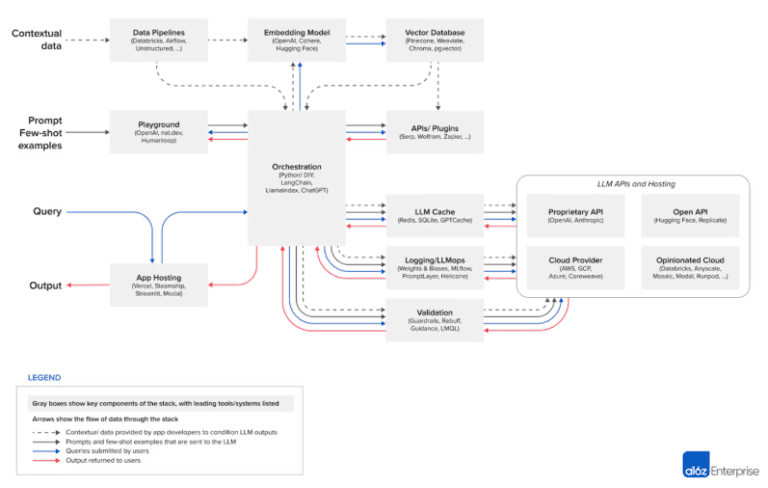
From data pipelines to app hosting, let’s dive into the intricate world of LLM architecture.
Data Pipelines
Data pipelines form the backbone of LLM applications, seamlessly managing data ingestion and transformation. They connect various sources, ingesting contextual data to feed into the LLM ecosystem.
- Ingestion: Connects diverse data sources, ensuring a continuous flow of contextual information.
- Transformation: Prepares and channels data for optimal use in LLM applications.
- Tools: Notable examples include Databricks, Airflow, and Unstructured.
Embedding Models
Embedding models transform data into a format that LLMs can understand, usually converting textual data into vectors.
- Data Transformation: Converts complex contextual data into a more manageable, mathematical format.
- Efficiency: Enables easier storage and computation, forming a bridge between raw data and AI processing.
- Tools: Prominent tools include OpenAI, Cohere, and Hugging Face.
Vector Databases
Vector databases store and manage the vector data generated by embedding models, crucial for the efficient operation of LLMs.
- Storage and Management: Specialized in handling vector data for easy retrieval and management.
- Querying Efficiency: Enhances the speed of data retrieval, crucial for real-time applications like chatbots.
- Tools: Examples include Pinecone, Weaviate, ChromaDB, and pgvector.
Playground
The playground environment is where AI prompts are iterated and tested, a vital step before full integration.
- Iteration and Testing: Allows for the fine-tuning of LLM prompts, ensuring they perform as intended.
- Optimization: A critical step for enhancing the overall performance and accuracy of LLM applications.
- Tools: Tools in this category include OpenAI and Humanloop.
Orchestration
Orchestration layers manage the coordination of various components and workflows within the LLM application.
- Coordination: Manages the intricate interactions between different components and workflows.
- Abstraction and Memory Management: Simplifies complex processes like prompt chaining and maintains continuity across multiple LLM interactions.
- Tools: Langchain, LlamaIndex, Flowise, and Langflow are notable examples.
APIs/Plugins
APIs and plugins extend the functionality of LLM applications, allowing them to interact with external tools and services.
- Interoperability: Enhances the ability of LLM apps to work with various external resources and services.
- Functionality Enhancement: Extends the capabilities of LLM applications, offering more versatile uses.
- Tools: Examples include Serp, Wolfram, and Zapier.
LLM Cache
The LLM Cache is a critical component for enhancing the speed and responsiveness of LLM applications.
- Speed and Accessibility: Stores frequently accessed data, reducing load times and improving overall performance.
- Reduced Latency: Enhances user experience by minimizing delays in data retrieval.
- Tools: Key tools include Redis, SQLite, and GPTCache.
Logging/LLM Ops
Logging and LLM Operations are essential for maintaining the health and performance of LLM applications.
- Monitoring and Tracking: Keeps a detailed log of application performance and system health.
- Proactive Issue Resolution: Helps in quickly identifying and addressing potential issues, ensuring smooth operation.
- Tools: Notable tools for this purpose are Weights & Biases, MLflow, PromptLayer, and Helicone.
Validation
Validation frameworks play a pivotal role in ensuring the output quality and reliability of LLM applications.
- Output Quality Control: Acts as a checkpoint to maintain the integrity and reliability of the application.
- Corrective Actions: Offers mechanisms to rectify any deviations or errors in the output.
- Tools: Examples include Guardrails, Rebuff, Microsoft Guidance, and LMQL.
App Hosting
App Hosting is the final layer in the LLM application architecture, crucial for deployment and accessibility.
- Deployment and Accessibility: Hosts the LLM application, making it accessible to end-users.
- Scaling and User Management: Provides the infrastructure necessary for scaling and managing user access.
- Tools: Platforms like Vercel, Steamship, Streamlit, and Modal are key in this area.
Conclusion
From data pipelines to orchestration, each component plays a pivotal role in the smooth functioning and scalability of these AI powerhouses.
As we continue to explore and innovate in this field, the architecture of LLM applications will undoubtedly evolve, offering even more possibilities for the future of AI technology.
Nandan Mullakara
AI Automation Strategist, Author, and Influencer
Nandan Mullakara is a strategic advisor, author, and podcaster on Intelligent Automation. The founder of Bot Nirvana, he is a key opinion leader in Onalytica's "Who's who in Automation". Nandan was most recently the head of RPA consultancy at Fujitsu America, where he enabled the Fujitsu Digital Workforce offering. He writes about Automation at nandan.info, and you can find his automation club and podcast at Botnirvana.org.
- A Complete Guide To Agentic Process Automation (APA) - January 21, 2025
- 5 Robotic Process Automation Use Cases You Should Know About - January 14, 2024
- What Is Intelligent Automation And What Can It Do? - January 7, 2024