2023 Clash of the ERP Titans – SAP vs. Oracle vs. Microsoft vs. Infor
-
 By
Dan Aldridge
, Director, Solutions Marketing at PCG
- Best Practices,


The four “titans” in this article—SAP, Oracle, Microsoft, and Infor—are considered the “tier 1” ERP vendors. This means that each vendor provides a flagship offering for companies with more than $750 million in annual revenue. Most companies of this size have complex processes and sophistication around consolidation and data management that other small to medium-sized ERP vendors can’t handle well.
Although these Tier 1 vendors tend to target enterprise-sized organizations, they also offer somewhat smaller company-sized ERP offerings. So, for example, SAP has SAP Business One, and Infor has Infor CloudSuite Industrial (Syteline).
My article is an expansion and exploration of the annual “Clash of the ERP Titans” survey done by Panorama Consulting Group. Because the respondents tended to be enterprise-level companies, the focus was on the larger flagship ERPs, such as SAP S/4HANA and Infor CloudSuite Automotive (LN).
Here’s the video summary of the 2022 study, which had very similar results:
The following sections are based on my notes and insights from the video, the PDF 2023 Clash of the Titans from Panorama Consulting Group, and my research on the topic.
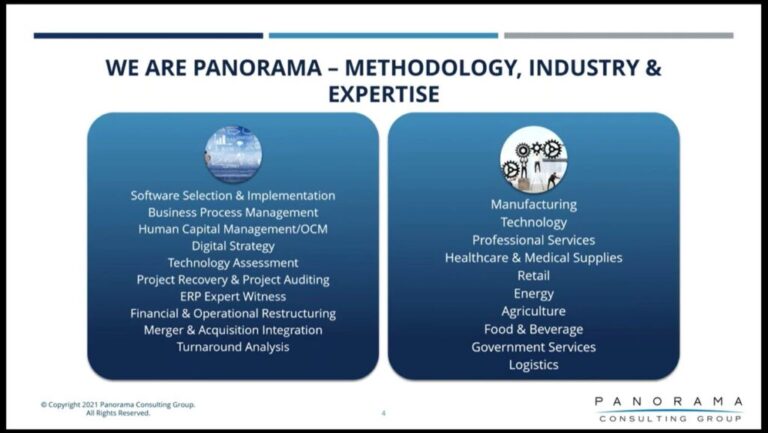
Panorama has focused on business and enterprise technology consulting. Software selection and implementation is their main line of business, along with organizational change management. Here is an overview slide from their presentation, which shows their areas of expertise.
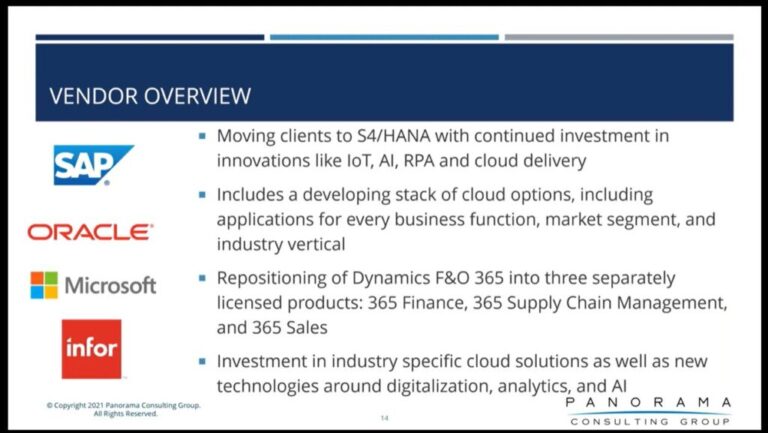
And this is a summary of the “Titans” from the presentation:
In the following sections, I’ve provided some overviews and my interpretations of the results of the Panorama Clash of the Titans study. I’ve also spliced in some of my articles and videos from analyst Eric Kimberling, formerly of Panorama and now with Third Stage Consulting Group.
SAP
SAP’s customers are typically enterprise-sized and midmarket companies. SAP solutions can be deployed in a public or private cloud or a hybrid environment. With customers on older versions, such as ECC or R/3, SAP is making a concerted effort to migrate them to the SAP S4/HANA cloud solution.
So, what is SAP S4/HANA Cloud? Here’s an independent overview of the solution by Eric Kimberling.
Surprisingly, in the study, SAP customers tended to have the lowest costs and the shortest durations. Panorama attributes this result to most respondents upgrading from ECC to S4/HANA rather than to more difficult migrations like R/3 to S4/HANA.
Here is a closer look at the Panorama survey findings for SAP:
- They had the most customers focused on supply chain issues, including transportation, warehousing, and inventory management.
- They had the least expensive projects this year.
- They had the shortest project duration this year.
- The SAP ERP implementation costs and timelines were the second largest.
The fact that the respondents reported focusing more on HCM is likely a function of trying to do more with fewer people. Accordingly, SAP customers reported that IT maintenance costs decreased due to moving to the cloud with S/4HANA.
Oracle
Oracle provides a set of core applications as well as industry-specific applications. The vendor has comprehensive cloud options, including public cloud, cloud at customer, and on-premises. Since NetSuite was repurchased by Oracle a few years back and it’s their small- to mid-sized company offering, some respondents reported having NetSuite. Still, most were on Oracle EBS Cloud, Oracle’s flagship offering for large companies.
Here’s an overview of Oracle EBS Cloud from Eric Kimberling.
In the Panorama study, Oracle had the most expensive projects and longest durations across the board. Possibly because of this, and because Oracle customers tend to develop KPIs for their projects up front, they also tended to achieve the highest benefits realization.
Oracle had:
- The most expensive projects.
- The longest-duration projects.
- The fewest number of customers who considered the projects to be digital business transformation. In other words, they considered them ERP initiatives only.
- A heavy focus on solving supply chain issues.
- Productivity, efficiency, IT maintenance costs, and customer experience improvements.
- The most significant improvements were in standardization and compliance compared to other vendors.
Microsoft
Microsoft’s enterprise software options include a variety of solutions within its Dynamics 365 offering. Microsoft is continually building new data centers to support its Azure cloud capabilities across its ERP solutions.
Many of the Microsoft respondents to the Panorama survey had:
- A focus on Sales and Customer Relationship Management (CRM) functionality.
- Most customers focus on Enterprise Asset Management (EAM) functionality rather than ERP, supply chain, and logistics.
- A strong emphasis on Reporting and Analytics, which is not surprising given Microsoft tools like Power BI.
- The greatest realized benefits were productivity, efficiency, customer experience, and user acceptance.
Infor
Infor’s focus has been on its industry-specific ERP solutions, which are designed for enterprise-level and small to medium-sized businesses. These solutions are delivered in a multi-tenant cloud. Infor’s flagship ERP is the Infor CloudSuite.
Infor customers in the Panorama study were mostly doing digital transformation projects rather than just ERP implementations. They were looking at budgeting, planning, compliance, operating models, and benefits realization.
In the study, Infor had:
- The most customers whose projects were digital business transformations.
- The most customers focused on Finance and Accounting, budgeting, and planning aspects of the software.
- The biggest benefits realization in standardization, compliance, and new operating models.
For fun, I did another article about a “face-off” head-to-head comparison between Infor and SAP called “Infor CloudSuite vs. SAP S4/HANA – Which is Better?” I hope you like it.
Dan Aldridge
Director, Solutions Marketing
With over 25 years of experience in corporate management and ERP consulting, Dan currently serves as Director of Solutions Marketing at PCG. In this role, his focus is on positioning partners’ software solutions, including Infor and NetSuite, to deliver market differentiation. His work involves collaboration with marketing, services, sales, and go-to-market teams to develop compelling messaging, positioning, and narratives tailored to specific verticals like Automotive and Aerospace & Defense.
- How to Upgrade Your Old ERP System To The Cloud, Without Dying - September 18, 2024
- What is iPaaS and How Can It Help Your Business? - January 28, 2024
- The Dark Secrets of an ERP Software Consultant - January 21, 2024