

AI in Education: Protecting Real Learning and Teacher Judgment
-
 By
Meghan Freeman
, Co-CEO at Illuminate XR
By
Meghan Freeman
, Co-CEO at Illuminate XR - Best Practices,
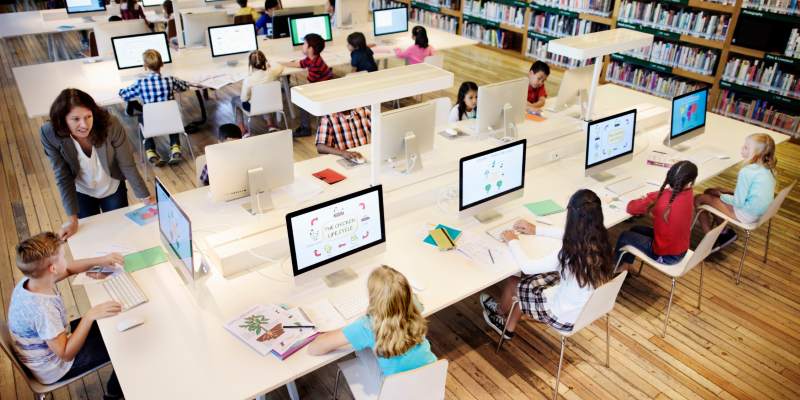
Meghan Freeman, Co-CEO of Illuminate XR, shares insights on AI in education, focusing on how schools can ensure they prioritize real learning and teacher judgment. This article originally appeared in Insight Jam, an enterprise IT community that enables human conversation on AI.
 Most teachers in classrooms today know the awkward pause. A teacher is reading through student work, probably tired, with a whole stack still sitting there, and one paper makes them stop. Maybe it is the writing, or the words feel older than they should. It could be that the reflection says exactly what the teacher hoped the student would understand, yet something about it feels disconnected from the child who shows up in class every day.
Good teachers know their students beyond what gets turned in. They hear half-answers during discussions. Most often, they see the crossed-out work and the student who looks completely lost, then somehow figures it out ten minutes later. Teachers know that for some students, writing does not come until they have talked it out, while for others, they overthink every sentence. A few race through the whole thing and circle back later when it finally clicks. Learning is rarely neat while it is happening, and every child approaches it differently.
Now the paper can look done long before the student has really done the thinking. That is what is hard in education right now. The answer may work, and the writing may sound strong on paper. Yet, the teacher is still left wondering if the student is actually doing the work at all. That uncertainty is where so many teachers are living right now.
AI Adoption in the Classroom
Students are already using AI, and no amount of pretending will change that. One may use it because they are stuck, and another may use it to untangle a thought. Plenty are using it to step around the struggle altogether because they can get away with it. Students will keep using these tools after they leave school, so blocking everything is not much of a plan. The question is whether students are still doing enough of their own thinking for the learning to stick with them.
A 2024 Walton Family Foundation survey found that more than 80 percent of teachers, parents, K-12 students, and college students said AI has had a positive impact on education. Another Walton survey found that almost half of teachers were already using AI-powered tools like ChatGPT at least once a week for things like lesson planning, grading support, quizzes, and assignments. AI is no longer sitting outside the school walls; it is part of the infrastructure, even before a school’s policies catch up.
For years, schools have put a lot of weight on what students turn in at the end. Essays are submitted, projects are graded, and quiz scores go in the book. Those pieces have a place, but they cannot carry the whole story on their own. Teachers have always known that. AI just made it harder to sweep under the rug.
The Limitations of AI Technology
Now more than ever, a teacher needs to see more than the clean version of any assignment. They must ask: Please include a side of thinking with that finished product? The idea has been around since Harvard’s Project Zero in the 1960s. What feels different now is that making thinking visible can no longer be the exception. Teachers must design assignments where the messy part is not something to erase. A lot of the truth lives there, and it must be evident. Designing for this kind of everyday learning is a shift that we need to see in education.
There is room for technology in this work, but it cannot and should never start acting like the teacher. Technology does not know the student who can explain everything out loud but struggles to write it down. It does not understand the child who looks distracted while quietly taking in every word. A revised response can give a teacher something useful, and so can a better question. None of it replaces the powerful relationship a good teacher can have with their students. At best, when designed correctly, it gives the teacher more of the story.
Detection tools may catch a few things, and they may get a few things wrong. That part matters. Stanford researchers found that AI detectors can falsely flag writing from non-native English speakers at much higher rates. So, when schools lean too hard on detection, the tool meant to protect learning can end up creating a new fairness problem. Detection tries to prove what happened after the fact. Redesigning learning makes student thinking visible before the final product ever arrives.
Either way, catching a student is not the same as teaching one. Learning design that focused on showing how a student arrived at a final product, not in a gotcha way, but in a way that makes the thinking part of the work again. When students learn that the goal is not just the final product, but the thinking behind it, things begin to shift.
Imagine a polished paper turned in with the thinking still attached. Some educators are already moving in this direction. They are asking students to turn in drafts, prompt logs, revision histories, notes in the margin, short reflection paragraphs, and quick explanations of what changed from the first idea to the final version. Others are bringing more of the thinking back into class through oral defenses, peer discussion, project work, in-class writing, and real-time problem solving. It is not about making school harder just to make a point. It is about ensuring the learning remains.
This is the transition schools are in now. Teachers need to ask questions not only after everything is finished, but while the thinking is still taking shape. What changed between drafts? Where did the idea start to fall apart? What still feels confusing? Those conversations are not extra. They are where the learning finally becomes real.
The Path Ahead: A Human-Centered Approach
AI can help a student get started or see an idea in a different way. It cannot be allowed to carry them around the productive struggle completely. That messy work is where understanding starts to take root, and teachers know it because they see it every day. The answer is usually only the cleanest part of the story. Better evidence often sits in the crossed-out work, the second attempt, and the question a student asks after realizing the first answer did not hold.
UNESCO’s guidance on generative AI in education calls for a human-centered approach, one that protects human agency and keeps people at the center of learning. That feels like the right focus for schools. AI can support the work, but teacher judgment, student thinking, and human connection must be what matter in today’s school.
Meghan Freeman
Co-CEO
Meghan Freeman, M.Ed., is an education leader, strategist, and learning innovator whose work focuses on how learning is designed, experienced, and supported in a rapidly changing world. After spending a decade in the classroom, she moved into educational leadership and later co-founded Elite Academic Academy, a California public charter school recognized as a California Distinguished School for closing achievement gaps and building student-centered learning models.