

You Cannot Prompt-Train Your Way to AI Adoption
-
 By
Paul Carney
, Founder & President at Ishtot, Inc.
By
Paul Carney
, Founder & President at Ishtot, Inc. - Best Practices,

Ishtot’s, Inc.’s Paul Carney offers this commentary on why you cannot prompt-train your way to AI adoption. This article originally appeared in Insight Jam, an enterprise IT community that enables human conversation on AI.
 I started my career as a high school math teacher, where I quickly learned that knowing a subject and knowing how to teach it are very different things.
Demonstrating how to solve an equation did not mean every student understood the concept or could apply it independently. Lasting learning required a curriculum built on foundational knowledge, guided practice, feedback, reinforcement, and opportunities to apply the concept in different situations.
That lesson stayed with me as I moved into corporate training and learning and development. It is especially relevant now as organizations prepare their people for artificial intelligence.
Too many organizations treat AI education as a short-term skills project. They introduce a tool, demonstrate a few features, provide sample prompts, review an acceptable-use policy, and expect employees to work differently.
Early adopters may move quickly, but many others will not. The issue is rarely a lack of intelligence or willingness. The problem is that organizations have introduced a tool without providing a complete learning journey that helps people change the habits surrounding how they work.
AI adoption is not simply a technology rollout. It is a human change-management process, and that process needs a curriculum-based approach.
AI Changes More Than the Tool We Use
Over the past two years, I have worked with thousands of people across organizations large and small, and I still encounter considerable hesitancy around AI.
Some people worry about what it means for their jobs while others distrust the results. Many feel overwhelmed by the pace of change or do not know where to begin. Still others have tried AI a few times, received a generic or inaccurate response, and concluded that it is not useful for their work.
Much of that hesitancy comes from not fully understanding what AI is, what it is not, and how people must interact with it to produce useful results.
AI looks deceptively simple. A blank text box invites us to type a question, much as we would use a search engine or message a colleague. That familiar interface hides the fact that working effectively with AI requires unfamiliar behaviors.
People must learn to externalize context they previously carried in their heads, define the outcome, establish boundaries, evaluate the response, and refine the work. They must also know when to trust an output, when to verify it, and when to reject it.
AI therefore changes more than the tool people use. It changes how work starts, how it flows, and how a final decision is made. It is a work-habit reset, not simply another application added to the technology stack.
A one-hour prompt-writing class may help someone produce a better response that afternoon. It does not necessarily prepare that person to redesign a recurring workflow, supervise AI-generated work, or apply human judgment consistently in higher-stakes situations.
That requires a broader educational approach.
The Weight-Loss Problem of Prompt-Train AI Adoption
AI adoption resembles another familiar challenge: losing weight.
A new diet or exercise program can create an initial burst of motivation and some quick results. Then comes the plateau.
The problem is rarely a total lack of knowledge. Most people already know that nutrition and physical activity matter. The challenge is incorporating healthier choices into daily life until they become habits. Sustainable improvement requires more than a temporary intervention. It requires a lifestyle change.
AI follows the same pattern. An employee discovers a clever prompt that saves an hour and feels an immediate sense of progress. But without a broader plan, that success remains isolated. The next task begins from a blank page, and yesterday’s “greatest hit” is forgotten.
This is why activity gets mistaken for strategy. Organizations may see considerable experimentation but little sustained change. Employees may be “using AI,” but sporadic use does not automatically become organizational capability.
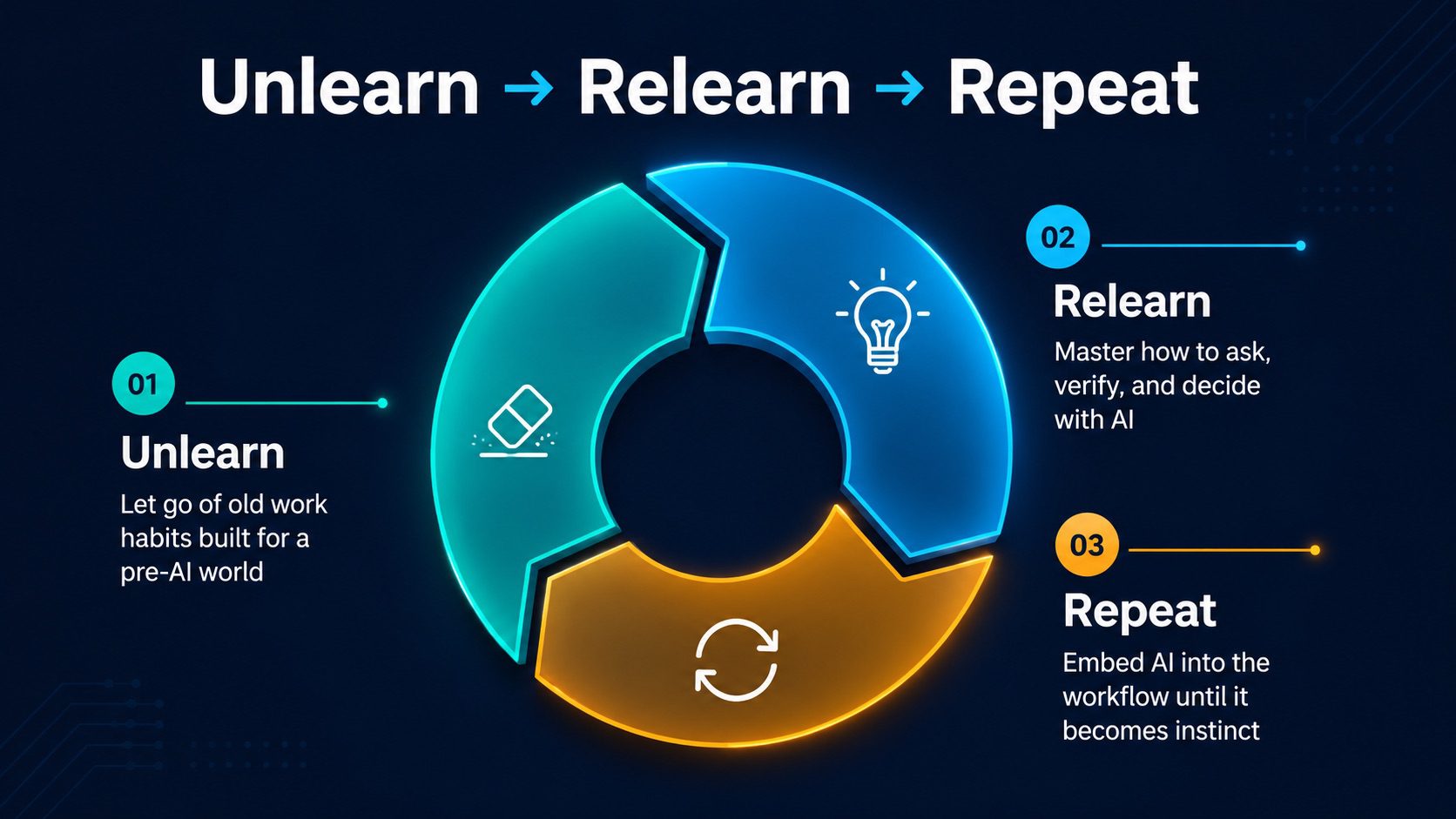
Lasting AI adoption requires a repeating cycle of unlearn → relearn → repeat.
Unlearn: Make Pre-AI Work Habits Visible
Unlearning does not mean asking people to abandon their professional expertise. That expertise becomes even more important when AI is involved. Unlearning means recognizing which assumptions and habits were developed for a pre-AI workplace and deciding which ones no longer serve us.
Many professionals have been conditioned to begin every project with a blank document and expect technology to respond correctly to a single command. When AI produces a weak result, they treat it as a failed transaction rather than the beginning of an iterative process.
Employees may also assume that using AI means surrendering ownership of the work. At the other extreme, they may assume that a polished AI response can be accepted without review. Both reactions misunderstand the human role.
AI can draft, organize, analyze, compare, challenge, and synthesize. People remain responsible for context, judgment, ethics, accuracy, stakeholder impact, and final approval. Productive AI adoption is about repositioning the human as the director of the process, not about removing the human from the process.
Education must help employees examine these habits directly. They need opportunities to compare old and AI-enabled workflows, see examples of both effective and ineffective AI use, and discuss how their professional responsibilities change when AI becomes part of the work. Without this unlearning stage, organizations risk placing AI on top of the same old processes and calling it transformation.
Relearn: Start with Comfort, Not Competence
Once people recognize that the work is changing, they must learn how to operate in the new environment. I think about this progression through the analogy of learning to swim.
Before someone can become a capable swimmer, they must first become comfortable entering the water. An instructor can explain every stroke and demonstrate proper breathing, but the instruction will not help someone who still believes they will sink the moment their feet leave the bottom.
Once comfort develops, the swimmer can build confidence through support, instruction, and practice. Perhaps flotation devices provide help at first. Eventually, those supports come off, and confidence begins turning into competence.
From there, the swimmer may remain casual, train as a lifeguard, or pursue competition-level achievements. The desired level of mastery varies, but the sequence does not: comfort comes before confidence, and confidence comes before competence.
Organizations frequently reverse that sequence with AI. They place a tool in employees’ hands, provide prompt training, and expect competence. They are teaching advanced swimming strokes before helping people become comfortable in the water.
This progression is part of what I call AIQ Fluency.
AIQ, or Artificial Intelligence Quotient, describes a person’s ability to understand, engage with, and collaborate with AI to get meaningful work done. Much as IQ relates to cognitive ability and EQ to emotional intelligence, AIQ reflects how effectively someone works in a human-AI partnership.
AIQ Fluency develops through three stages:
- Comfort: Comes from understanding what AI can and cannot do, why it works the way it does, and why it sometimes produces frustrating or surprising results.
- Confidence: Grows as people learn to communicate clearly, provide context, define intent, establish constraints, request a useful output, and verify what they receive.
- Competence: Emerges when they can apply those behaviors consistently to meaningful work.
The lightbulb moment is remarkable to watch. Once hesitant employees gain enough comfort and confidence, they stop asking only, “What prompt should I use?” and they begin asking, “Where could AI improve this process?” or “How could I build this so I do not have to start over next time?”
At that point, they are becoming AI-first thinkers.
Repeat: Practice Until the Workflow Changes
Unlearning creates awareness, relearning builds new skills, and repetition turns those skills into habits. This is where many AI programs fall apart.
An introductory course may generate enthusiasm, but employees return to full calendars, established processes, and managers who may not reinforce the new behaviors. Without deliberate practice, the old work habits quickly return.
Effective AI education must extend beyond the classroom. Employees need role-relevant assignments, opportunities to apply AI to authentic work, and feedback on how they approached the process, not merely whether they generated an acceptable answer.
They should practice refining weak outputs, questioning AI’s logic, identifying hidden assumptions, and verifying claims. As their skills develop, they should move beyond one-off prompts and build reusable profiles, snippets, templates, and workflows.
The progression matters. Applied learning should begin with accurate work context and structured communication, then advance toward evaluation, analysis, reusable workflows, and responsible implementation. The goal is not to complete disconnected exercises. It is to develop a repeatable way of thinking and working.
And managers also play an essential role. They must model responsible AI use, create psychological safety for experimentation, discuss lessons from unsuccessful attempts, and give employees time to practice.
AI learning cannot be relegated to an optional activity people pursue after their “real work” is complete. The learning process is directly linked to how the real work is changing.
Start Before the Next Tool Arrives
AI tools will continue to evolve, and features demonstrated today may change within months. A training strategy built around one interface will always struggle to keep pace.
A curriculum-driven approach builds more durable capabilities: framing problems, communicating intent, testing assumptions, verifying evidence, protecting sensitive information, exercising judgment, and turning successful interactions into repeatable systems. Those capabilities transfer across tools and remain valuable as the technology changes.
Organizations should measure those capabilities, not merely course completion, login activity, or the number of prompts employees submit. Look for evidence that people are improving decisions, redirecting time toward higher-value work, discovering useful applications, sharing what they learn, and becoming more confident without becoming overconfident.
And there is no reason to wait for a perfect enterprise strategy or the next generation of AI tools. Start with one team and one recurring workflow. Identify the old habit that needs to be unlearned. Teach employees a repeatable way to work with AI. Give them time to practice, receive feedback in a learning environment that accepts failure, and document what works. Then measure the change and repeat the cycle.
AI adoption will not become easier simply because organizations postpone the human work. Tomorrow’s AI will arrive whether their people are ready or not. Which is why the work of preparing them must begin today.

Paul Carney
Founder & President
Paul is a global speaker, educator, and former Chief Human Resources Officer with more than 35 years of experience leading business, technology, and HR transformation. A Certified AI Expert. He helps organizations adopt AI responsibly and practically, with a focus on measurable results.