Fast, Cost-Effective Innovation: What AWS Customers Got at AWS re:Invent
By Kevin Petrie and Shawn Rogers
Amazon Web Services (AWS) users swarmed Las Vegas last week to network, learn, and buzz about artificial intelligence (AI). Five days and 101 announcements later, what have they walked away with? This blog evaluates re:Invent 2025 from the customer perspective, leveraging new BARC research that assesses the needs of 421 global AI adopters, especially the 120 respondents who rely on AWS.
These AWS users have four notable priorities for AI: rapid innovation, cost control, multimodal AI, and governance. AWS hit the mark with three out of four, announcing capabilities that speed innovation, improve cost control, and enable multimodal AI. But they had one miss: there was not enough about data governance.
Rapid Innovation
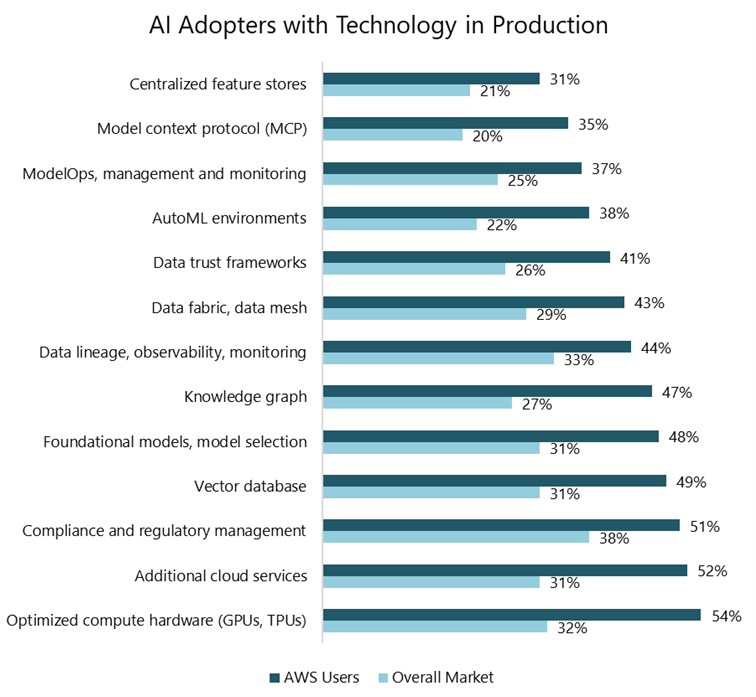
Speed is a priority for everyone these days as executives realize that hesitation with AI might cost them revenue, profits, and market share. AWS users, as you might guess, move fast to avoid this fate. Most of them (72%) are in production with AI, compared with 50% of the overall market. Customer satisfaction tops their list of success measures for AI, reflecting a solid focus on business fundamentals rather than science experiments.
To support their endeavors, AWS users are in much higher levels of production with every type of AI-related technology compared with their peers.
As one would expect, Amazon hit the bullseye for rapid innovation. For example:
- Amazon Nova Forge enables data science teams to train generative AI (GenAI) models on their proprietary data, enriched with AWS data. This provides a higher level of customization than traditional approaches such as retrieval-augmented generation (RAG) or fine-tuning, provided organizations keep a close eye on compute and token costs.
- Amazon Nova Act helps design, build, and manage AI agents that navigate websites and fill out online forms to help humans save time on everyday tasks. If properly supervised, these agents can help organizations streamline operations and boost employee productivity.
Cost Control
This brings us to the critical priority of cost control. Nearly one third (30%) of AWS users rate high costs and budget constraints as a major AI obstacle, and 29% of them use cost as a success measure for AI. High costs force them to limit the scope of projects, deliver in stages, or take other restrictive measures. They must regain control of their software, compute, and token fees.
AWS gets the message. For example, it announced the following:
- Amazon’s new Nova 2 Lite model gives users control over its sequential reasoning capabilities. They can specify their budget level based on the speed and sophistication of the task at hand.
- Its EC2 Trn3 UltraServers improve the efficiency of GenAI model training, fine-tuning, and inference to make experiments more affordable.
- Amazon also now offers Database Savings Plans that cut charges up to 35% for predictable workloads that have consistent hourly usage levels.
- The Amazon OpenSearch Service helps build large vector databases faster and at lower cost using serverless GPU acceleration and automatic index tuning.
Such announcements ease some of the pressure on data and AI leaders as they struggle to support rigorous business demands within existing budgets.
Multimodal AI
AWS users love multimodal AI. In fact, 47% of them say image, video, and sound data is critical to their AI innovation, compared with 33% for the rest of the market. AWS hit the mark here with two new releases.
- Amazon Nova 2 Omni, available in early access to Nova Forge customers, provides multimodal reasoning and image generation in a single model that consumes text, image, video, and speech inputs. This opens a wide range of use cases while saving data science teams the trouble of orchestrating multiple models.
- Amazon Nova 2 Sonic, now generally available, enables conversational AI with a polyglot speech-to-speech model. Developers can now build applications that speak English, German, Hindi, and so on, even switching between languages if needed.
Data and AI Governance
Adopters understand that AI, while promising, also poses significant risks to their business. In fact, just 41% of executives believe the productivity benefits of agents outweigh the risks, according to a recent survey by Capgemini. That’s down from 57% last year. AWS addressed these concerns partly with new governance and security features for agents. For example, Amazon Bedrock AgentCore helps evaluate and control agent behavior, and a new AWS Security Agent hardens the application development lifecycle.
However, AWS said little if anything about data quality, which its users now rank as the #1 obstacle to AI success. AWS does help customers in this regard; AWS Data Quality, for example, automatically recommends rules, monitors adherence, and helps resolve issues. But re:Invent missed the mark this year by failing to address this acute customer pain point with any meaningful enhancements or advice.
AWS re:Invent 2025 showed customers that AWS is moving quickly to support their top AI priorities, delivering new capabilities that accelerate innovation, improve cost efficiency, and expand multimodal AI options. However, the event also exposed a critical gap: AWS still has not given data leaders the stronger guidance and tooling they need to tackle data quality, their most pressing governance challenge. As organizations push forward with AI at scale, they should take advantage of AWS’s innovation and cost-control advances while demanding—and building—the governance foundations required for trustworthy, production-ready outcomes.