Meet the Cloud AI Innovators: Executive-Led, Business-Focused, and In Production
Amid the haphazard rush to artificial intelligence (AI), one cohort of smart adopters deserves a close look: the Cloud AI Innovators. Their cloud-first, converged approach to machine learning and generative AI puts them on the bleeding edge. It also simplifies technical integration work, freeing up energy to define executive leadership, establish business metrics, and push more data into production.
This blog, the first in a two-part series, profiles Cloud AI Innovators (“Innovators”) based on exclusive survey findings by BARC. We identify three distinguishing characteristics for this group of 31 survey respondents. Compared with our control group of 370 adopters, Cloud AI Innovators are more likely to:
- Have executive-led AI programs
- Place a high priority on business results
- Have data in production with AI
Our second blog in the series will assess the lessons that these smart adopters can teach everyone else. We’ll follow the blogs with video interviews that examine actual Innovators’ best practices using Google’s Data Cloud.
Definition
BARC defines a Cloud AI Innovator as an organization that runs full AI projects on one public cloud. The projects include feature engineering, AI model training/fine-tuning, model evaluation/testing, model inference, production applications, and retrieval-augmented generation (RAG). To focus on converged platforms, we exclude survey respondents who host any project elements (beyond raw source data) on premises, in hybrid environments, or in multiple clouds. Converged cloud platforms simplify how cross-functional teams integrate their datasets, models, applications, and business workflows. They also give these data engineers, data scientists, and developers unified access to advanced tooling.
BARC defines a Cloud AI Innovator as an organization that runs full AI projects on one public cloud.
To be sure, a converged cloud approach is not easy for many organizations to achieve. Migration complexity, data gravity, and sovereignty requirements often force AI teams to run project elements elsewhere—for example, they might handle feature engineering alongside raw source data on premises. Reflecting this reality, the control group divides overall AI workloads evenly between on-prem, hybrid, and multi-cloud environments according to BARC surveys.
But by profiling this small group of Cloud AI Innovators, we can help other organizations learn best practices and identify their own projects for converged cloud platforms.
Why implement AI?
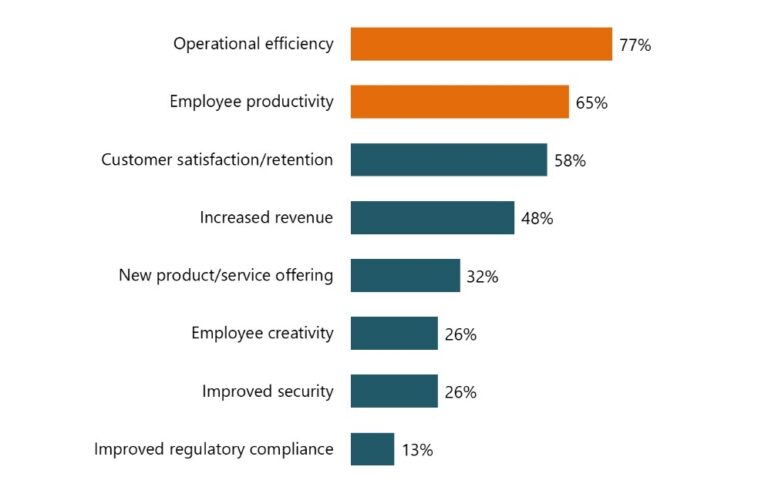
Let’s start with the motivation for AI. Like other organizations, Innovators prioritize cost reduction over other objectives. In fact, 77% seek operational efficiency and 65% seek employee productivity. And most (55%) meet or exceed their objectives.
What are the primary business objectives of your company’s AI initiatives?
Executive-Led
The biggest standout trait of an Innovator is human: namely, executive leadership. Nearly two-thirds (62%) have an executive AI leader, double that of the control group. And one-third (33%) have a mature, cross-functional AI program that addresses six additional requirements: project governance oversight; legal considerations; standards and policies; security standards and compliance; enterprise architecture requirements; and data access/use policies. These programs demonstrate an obsession with detailed planning, execution, and risk management.
Nearly two-thirds of Cloud AI Innovators have an executive AI leader, double that of other organizations.
Business-Focused
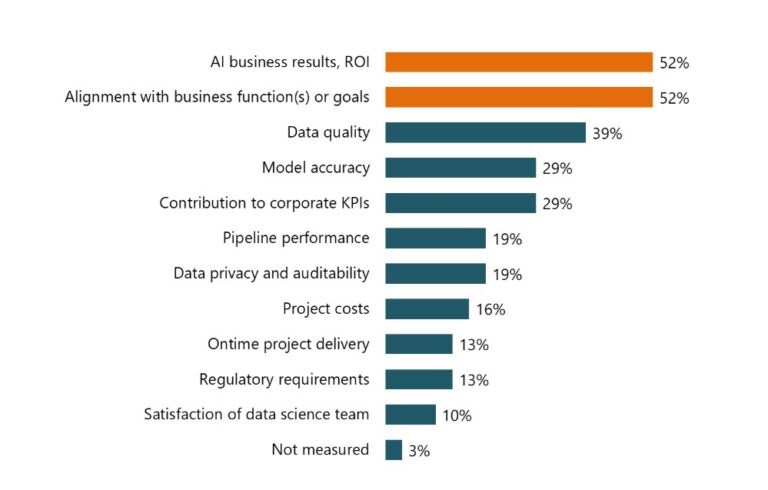
Rather than chasing shiny objects, Innovators manage their technical teams with an eye toward bottom-line benefits. In fact, AI business results/ROI and business goal alignment rank as the two most popular success measures for data management, chosen by 52% of respondents each. This compares with 35% and 32% respectively for the control group. They have the right priorities. While data quality, pipeline performance, and delivery times all matter, the ultimate success measure is data teams’ contribution to corporate performance.
Innovators’ data teams focus on bottom-line benefits more than shiny objects
What are the top three ways in which you measure the success of your data management activities that support AI?
In Production
Converged cloud platforms enable Innovators to push more data into production faster than others. They have fewer datasets to migrate and fewer tools to integrate, because all their elements reside in the same cloud. This simplifies many processes. For example, it reduces the time required for data engineers to define and refine features, for data scientists to train machine learning (ML) models, and for cross-functional teams to build RAG workflows for generative AI (GenAI). Operating on one cloud, Innovators can push their models into production faster and feed them more AI-ready datasets.
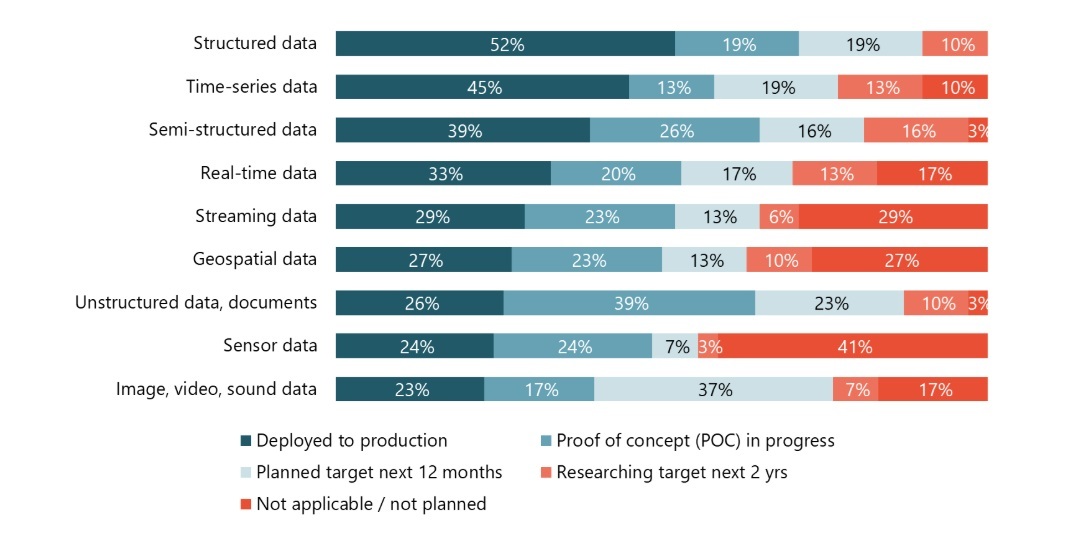
Reflecting this readiness, Cloud AI innovators feed more inputs to production AI models across nearly all data types. Structured (i.e., tabular) data remains the favorite AI input because it is easier to validate and govern. Most Innovators (52%) have structured data in production, vs. 42% for the control group, followed by 45% of time-series data (vs. 32%) and 39% (vs. 28%) of semi-structured data. Innovators lag in their production delivery of just one data type: image, video, and sound. They have just 23% of this data type in production with AI, compared with 32% for other adopters.
Unstructured data, in POC with 39% of Innovators, represents the next wave of AI innovation. These emails, documents, images, and other unstructured objects provide critical context and proprietary insights to AI adopters. We should expect explosive adoption of unstructured data for AI in coming years.
How is your organization utilizing each of the following data types for AI?
Work To Do
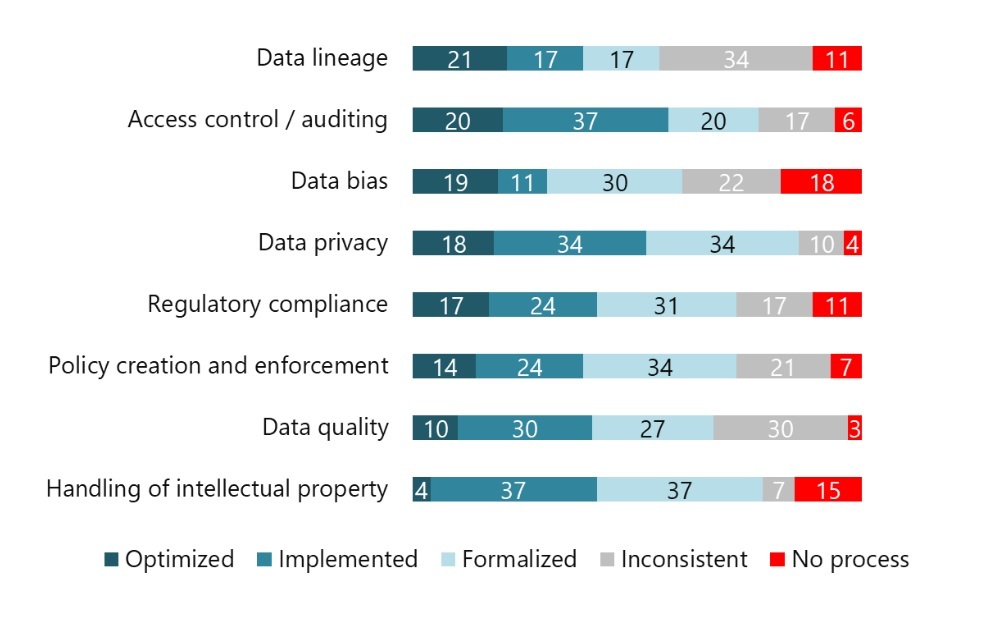
All AI initiatives depend on clean inputs and rigorous governance, starting with data governance. Like everyone, Innovators have work to do in this area. They show mixed levels of maturity for various governance controls: while most (57%) have implemented or even optimized their access controls and auditing, only 40% have done so in the critical area of data quality. While concerning, this patchy progress in governance is not uncommon. It does, however, need urgent attention because ungoverned inputs raise the risk of bad outcomes from probabilistic GenAI models and autonomous agents.
Please rate how well your organization addresses the following aspects of data governance in support of AI initiatives:
Next Steps
Cloud AI Innovators stand out for their executive-led strategies, business-focused priorities, and ability to operationalize AI in production through converged cloud platforms. Their unified environments simplify technical complexity, allowing them to move faster while keeping their efforts aligned with measurable business outcomes. Yet even these leaders recognize that stronger data governance will be essential to sustain progress and scale AI responsibly. Organizations seeking similar success should start by building similar executive-led AI programs and defining business metrics for their IT teams—and identifying potential projects to host on a converged cloud platform. In our next blog, we will parse the key lessons we can learn from the Cloud AI Innovators.
This work was sponsored by Google.