
The Next Planning Challenge isn’t AI, it’s Data
-
 By
Kelley Lynn Kassa
, Senior Analyst, Data & Analytics at BARC
By
Kelley Lynn Kassa
, Senior Analyst, Data & Analytics at BARC - Best Practices,

BARC’s Kelley Lynn Kassa offers commentary on why data is the next real planning challenge companies need to face. This article originally appeared in Insight Jam, an enterprise IT community that enables human conversation on AI.

Everyone is talking about artificial intelligence (AI) in planning.
The excitement is understandable. Vendors are rapidly introducing new AI capabilities, and organizations are eager to understand how those innovations can improve planning, forecasting, and decision-making.
But AI is also shining a spotlight on a challenge that has existed for decades.
At BARC, we’ve spent years discussing the importance of data management, integration, and governance in enterprise performance management (EPM). What has changed is not the importance of these topics, but the urgency of addressing them.
That’s one reason the recent announcement from Workday and Incorta stood out to me.
The planning industry has been talking about connecting operational planning and financial planning for nearly 25 years. I spent much of my career around those conversations.
So when I read the announcement about Incorta’s new Adaptive Data Foundation for Workday Adaptive Planning, I saw it as another step toward a vision the industry has been pursuing for decades.
In rowing, there’s a concept called swing. It’s the moment when everyone in the boat is in sync and the shell runs efficiently. That’s the “magic” of rowing. But it can be elusive. More often, you can have talented athletes and a fast boat, but without swing, the crew will never reach its full potential (watch The Boys in the Boat to see how this works).
Planning is similar. Organizations have spent years improving forecasting, analytics, and decision-making. The challenge has been getting operational planning and financial planning moving together and, more importantly, working from the same timely, trusted data.
Solving the problem has become more urgent. A decade ago, the conversation focused on improving forecast accuracy, reducing manual effort, and giving planners better visibility into operational drivers.
Those goals haven’t changed. What has changed is the environment in which planning operates. Organizations are increasingly looking to implement AI-supported analysis, decision intelligence, and more autonomous workflows.
That raises the stakes. It’s no longer enough to build a better forecast. Organizations also need the data foundations required to support the models, analyses, and AI capabilities that increasingly influence decision-making.
The challenge of connecting operational and financial data isn’t new. But as AI becomes more embedded in planning processes, the quality, accessibility, timeliness, and business context of that data become far more important.
Recent vendor announcements illustrate how the market is responding to this challenge. One example is Incorta’s Adaptive Data Foundation for Workday Adaptive Planning, a finance-owned data layer designed to give FP&A (financial planning and analysis) teams direct access to detailed operational data without relying on complex integration processes.
Workday and Incorta are not alone. Across the EPM market, vendors are pursuing different strategies to bring financial and operational data closer together. Some are investing in tighter integration between planning applications and operational systems. Others are extending planning capabilities onto existing data platforms or emphasizing shared data foundations that support planning, analytics, and AI from a common source of trusted data.
While the architectures differ, the underlying objective is remarkably consistent: giving finance teams faster access to trusted operational data and creating a stronger foundation for planning, analytics, and AI-driven decision-making.
Planning Has Become More Connected
BARC’s Planning Survey results show that connected planning is already mainstream. Self-service planning, planning and analytics integration, operational planning integration, and cloud planning all exceeded 50% adoption in both The Planning Survey 25 and The Planning Survey 26. At the same time, adoption of predictive planning and forecasting accelerated sharply from 11% to 27%, increasing the need for timely, trusted operational data.
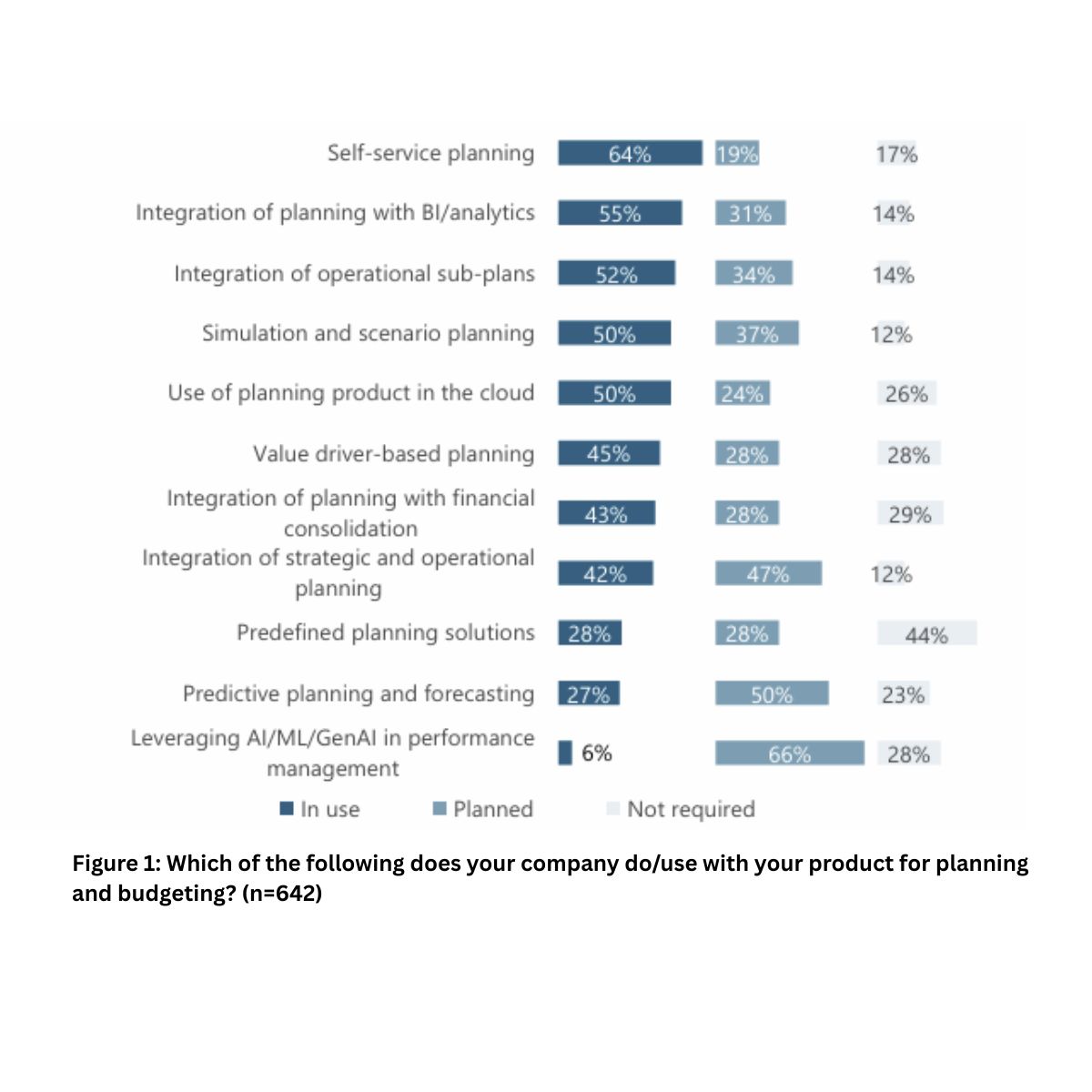
The benefits of connected planning are clear. Organizations are increasingly aligning financial and operational planning, integrating planning with analytics, and expanding participation beyond finance.
But greater connectivity creates greater dependence on data. As planning environments become more integrated, timely, trusted, and governed information becomes essential. For many organizations, that remains the limiting factor. One consequence of this shift is growing demand for operational data.
Why Operational Data Matters
The Incorta announcement reflects a broader market trend: planning teams increasingly want access to the operational drivers behind financial performance.
Revenue forecasts depend on sales activity. Workforce plans depend on Human Resources (HR) data. Supply chain decisions depend on inventory, procurement, and operational metrics.
As planning becomes more connected and data-driven, summarized financial data is often no longer enough. Organizations want visibility into the business events that shape outcomes and the operational signals that help explain them.
That need is not new. But the rise of predictive planning, AI-driven analysis, and faster decision cycles is making it more important than ever.
AI Is Making the Issue Impossible to Ignore
Nearly every EPM vendor now offers AI capabilities or has articulated an AI strategy.
We’re seeing planning assistants, copilots, decision intelligence capabilities, and increasingly, agentic AI concepts entering the market.
But all of these innovations share a common dependency: data.
One of the biggest misconceptions surrounding AI in planning is that the challenge is the AI model itself.
In many cases, the bigger challenge is the data foundation underneath it.
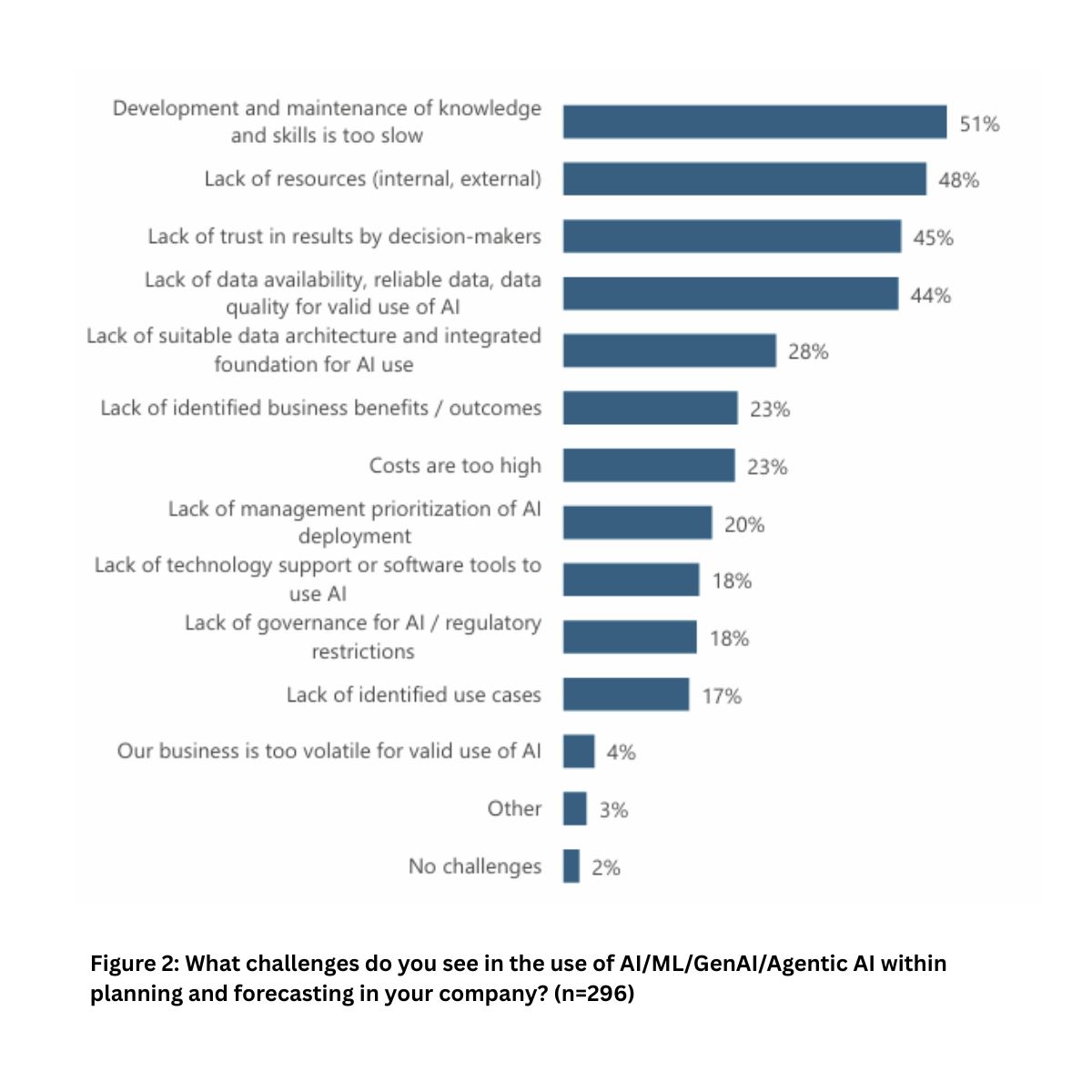
The findings from BARC’s Planning Survey 26 reinforce this point. When asked about challenges in the use of AI, respondents cited knowledge and skills (51%) and resource constraints (48%) most frequently. However, concerns related to trust, data quality, and data architecture also ranked highly:
- 45% reported a lack of trust in AI-generated results
- 44% cited issues with data availability and quality
- 28% pointed to shortcomings in data architecture and integrated foundations for AI use
These findings highlight a reality that many organizations are now confronting: successful AI initiatives require more than new functionality. They require trusted, accessible, and well-governed data.
This challenge is reflected in BARC’s CPM Trend Monitor 2026, where data management emerged as the most important trend shaping the future of CPM, ahead of many of the AI-focused capabilities currently receiving attention.
The Emergence of The Finance Data Foundation
Finance leaders are operating in an increasingly volatile environment. Supply chain disruptions, shifting customer demand, labor shortages, geopolitical uncertainty, and rapidly changing market conditions can all affect business performance long before those impacts appear in financial statements.
As a result, finance teams are looking beyond traditional financial data. They want greater visibility into the operational drivers behind business performance and faster access to the information needed to understand changing conditions. In some cases, that means access to transaction-level detail rather than summarized reports.
What’s emerging across the market is the concept of a finance data foundation: a governed layer that brings together financial and operational data and makes it available for planning, analysis, forecasting, and AI-driven decision-making.
Vendors are taking different approaches to this challenge. Some are focused on reducing the distance between planning systems and operational data. Others are emphasizing governance, data quality, and AI readiness. Still others are working to unify financial and operational planning on a common foundation.
The technologies may differ, but the objective is remarkably consistent. Finance teams want faster access to data, fewer manual workarounds, and greater confidence that decisions are being made using trusted, current information.
Looking Ahead
The Incorta announcement is noteworthy, but not because of the integration itself. What makes it interesting is what it reveals about the direction of the planning market.
For years, planning software vendors competed primarily on modeling capabilities, forecasting techniques, workflow management, and user experience. Those capabilities remain important and continue to evolve.
Increasingly, however, attention is shifting to the data that powers those processes. As planning becomes more connected and AI becomes more embedded in finance workflows, the quality, accessibility, governance, and context of data are becoming strategic considerations rather than technical ones.
The next challenge is not simply building smarter planning models. It is creating the data foundations that enable those models and the AI capabilities built on top of them to deliver reliable outcomes.
In that sense, the future of planning may depend less on how organizations model decisions and more on how they manage the information that powers the models. The next phase of innovation will not be defined solely by better models or more sophisticated AI. It will also depend on providing those systems with the business context needed to generate relevant, trustworthy insights.
The next installments of the series will cover why planning needs a comprehensive data foundation, how EPM vendors are rethinking data foundations, trust in AI and why AI needs context.

Kelley Lynn Kassa
Senior Analyst, Data & Analytics
Kelley Lynn Kassa is a seasoned marketing executive specializing in Corporate Performance Management, with more than 20 years of experience in marketing and communications in software and advisory services. She has held key roles at Applix, IBM, Varicent, and Datawatch, and BPM Partners, and for the past 13 years has provided marketing thought leadership content and programs for Revelwood—an implementation partner for IBM Planning Analytics, Workday Adaptive Planning, BlackLine, and Incorta.
- Why Workforce Planning is Now Central to Modern FP&A - March 13, 2026
- CPM Trend: Scenario Planning as a Strategic Response to Volatility - December 11, 2025
- The Strategic Imperative for CFOs to be AI Entrepreneurs - December 5, 2025