Harnessing Unstructured Data for Agentic AI: A 3-Stage Maturity Model
Sponsored by Ohalo.
Everyone knows context is king in the world of agentic AI. What needs more attention is the pivotal role of unstructured data in building the context that really differentiates your organization. Most AI adopters remain immature in this area. They struggle to organize and consume their proprietary documents, emails, and images.
But, where to begin? This blog proposes a three-stage maturity model that helps data and AI teams understand their baseline, then establish and optimize data management processes. Our model spans the discovery, refinement, access, validation, and tracing of unstructured data objects. We inform this model with new findings from our BARC Report, Harnessing Unstructured Data for AI Innovation, coauthored by Merv Adrian.
Maturity Model for Unstructured Data Management
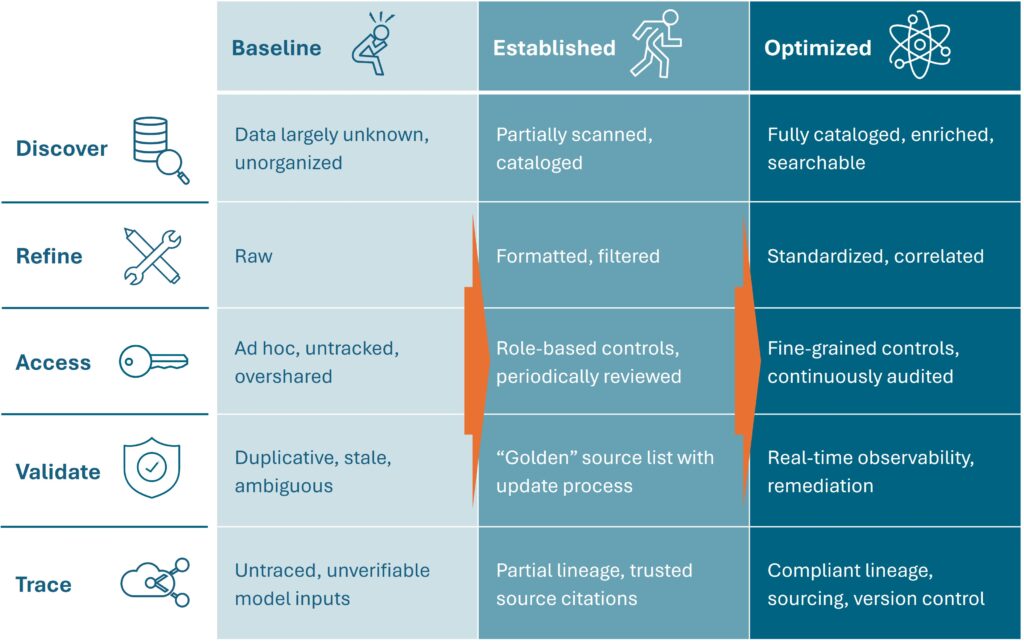 Our maturity model spans the discovery, refinement, access, validation, and tracing of unstructured data objects
Stage 1: Baseline
The “baseline” maturity level, where most AI adopters stand today, is sobering. These organizations have raw, duplicative, and often stale inputs that sprawl across complex and distributed environments. They cannot find all the unstructured data they need, and have no consistent practices for classifying, indexing, and assigning ownership of what they do find. They lack controls for data quality, lineage controls, and policy enforcement. AI teams consume these inputs on an ad-hoc basis with no monitoring, validation, or tracing. We estimate that about 50 percent to 70 percent of organizations remain in this baseline maturity level.
- 71 percent do not fully know where all their relevant unstructured data resides
- 64 percent cannot consistently enforce access and usage policies
- 53 percent have not implemented lineage tools
50 to 70 percent of organizations have just a baseline maturity for managing unstructured data.
What does this look like in practice?
Picture a regional insurance carrier, CoverMe, that processes claims through a cloud-based portal. Unstructured objects such as adjuster notes, customer emails, scanned medical records, and third-party inspection reports land in a mix of cloud storage buckets and SharePoint sites with no consistent tagging or taxonomy.
When CoverMe’s AI team launches an agentic assistant for claims triage, the agents piece together inputs and retrieval sources on an ad-hoc basis. Their embedded GenAI and ML models lack the necessary framework to cite consistent trusted sources or follow consistent logic. The agents burn unnecessary tokens, straining budget limits, and force claims adjusters to spend extra time fact-checking their outputs. This agentic AI initiative falls short of its ROI goals.
Stage 2: Established
The “established” maturity level shows meaningful improvement over the baseline. Organizations at this level scan, index, and catalog a portion of unstructured objects that business owners and AI experts identify for initial projects. They format and filter the AI inputs within these “golden” sources and start to implement governance constraints such as role-based access controls and lineage views that link model inputs to outputs. They also train stakeholders to follow formal processes for curating legal documents, customer records, and so on.
Organizations with established maturity levels organize and consume a portion of unstructured objects to support initial AI projects.
For example, suppose a regional hospital chain, StayWell, embarks on an AI initiative to streamline discharges and improve patient outcomes in its cardiology unit. Its data and AI teams catalog cardiology examination reports, physician notes, discharge summaries, and patient histories. They tag them with metadata that captures document type, originating department, and primary care provider.
StayWell implements an internal agentic assistant that reviews all this information and generates simple but comprehensive patient recommendations about self-care, symptom management, and future visits. This helps the discharge nurse better educate the patient at checkout, which reduces follow-on patient inquiries by 30 percent and unnecessary ER visits by 15 percent.
Stage 3: Optimized
The “optimized” maturity level opens the way for much broader gains. These AI adopters lay a similar foundation as the “established” camp, but they do so across most or all business units. And their data and AI teams go further to build the context that drives competitive advantage. They catalog, format, filter, and enrich relevant unstructured data across the enterprise. This gives them a standardized, comprehensive view of agentic AI inputs and enables them to correlate wide-ranging data points.
Optimized organizations also tighten governance with user-, row-, and column-level access controls; continuous auditing; and real-time observability and remediation of data quality issues. Authorized users can trace detailed lineage and source versioning to inspect the quality of agentic outputs.
Picture a global factory equipment manufacturer, Cog, that has scaled its unstructured data foundation across business functions, from engineering and procurement to field service. Its data and AI teams have cataloged, tagged, and enriched millions of unstructured objects enterprise-wide. This creates detailed, governed views of equipment schematics, supplier contracts, technician service reports, and warranty claims.
Cog’s agentic assistants correlate field failure patterns with engineering specifications and supplier records across product lines, enabling the company to predict equipment failures weeks in advance and cut warranty costs by 22 percent year over year. They deliver these results while operating within strict governance guardrails to ensure compliance with global regulatory requirements.
Putting Things In Context
Legendary programmer Alan Kay has observed that “context is worth 80 IQ points.” But AI agents cannot get all that context from structured tables alone. Their human governors must modernize how they discover, refine, access, validate, and trace rich unstructured inputs in order to boost agentic IQ and deliver on stratospheric market expectations. To learn more about a solution that can help, be sure to check out Data X-Ray from Ohalo.