Intersystems Summit 2026: A Peek Into Converged AI Workloads
InterSystems gets me excited for a few reasons.
They are proud to be privately held, their AR team rocks, and President Don Woodlock shares my love of kayaking.
But the most exciting part of their analyst summit last week was peeking into the world of converged workloads that will make or break the success of AI.
Intersystems has a home-court advantage in this space.
This Boston-based vendor has long experience processing transactions and analytics concurrently in their multi modal database, dubbed IRIS.
This runtime expertise will help optimize agentic AI workflows at scale, in particular to manage patient records for healthcare organizations large and small.
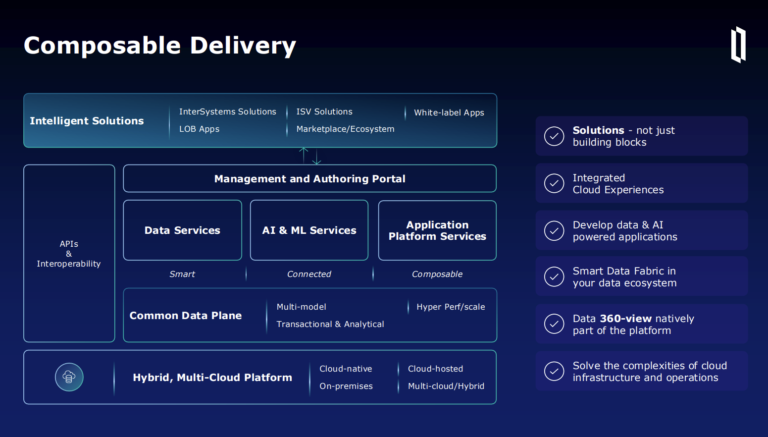
IRIS, now offered as a managed service, organizes data objects such as tables, documents, and images.
It retrieves them via SQL queries, graph queries, and semantic search in a governed framework.
And it contributes to a data fabric that consolidates multi-sourced data and manages the DB, analytics, and APIs with one integrated system rather than multiple overlapping tools.
Users can peruse and prepare distributed data for consumption with Intersystems Data Studio, now with the help of its AI Assistant.
Intersystems goes further to offer a common data and “context plane” with metadata, semantics, and conceptual models such as knowledge graphs that together enable context engineering for AI.
Users also can build MCP-enabled agentic workflows on top with Intersystems’ new AI Hub offering.
In addition, Intersystems addresses rising sovereignty concerns with its private cloud offering for IRIS.
All this provides a solid “data backbone” for agentic AI that combines operations and analytics.
Many AI adopters overlook Intersystems amidst their enthusiasm for AI gorillas like Google Cloud.
Intersystems is a well-kept secret in part because database take outs are hard, especially for operations.
It’s one thing to convince an enterprise to move some analytics data into Databricks or a hyperscaler, thereby gaining access to world-leading AI tools.
It is quite another to convince that same enterprise to migrate their mission-critical operations off of Oracle or SAP and onto Intersystems. Because migrating operational workloads disrupts established business processes.
To navigate this challenge, Intersystems offers a composable architecture that plays nicely with heterogeneous enterprise environments.
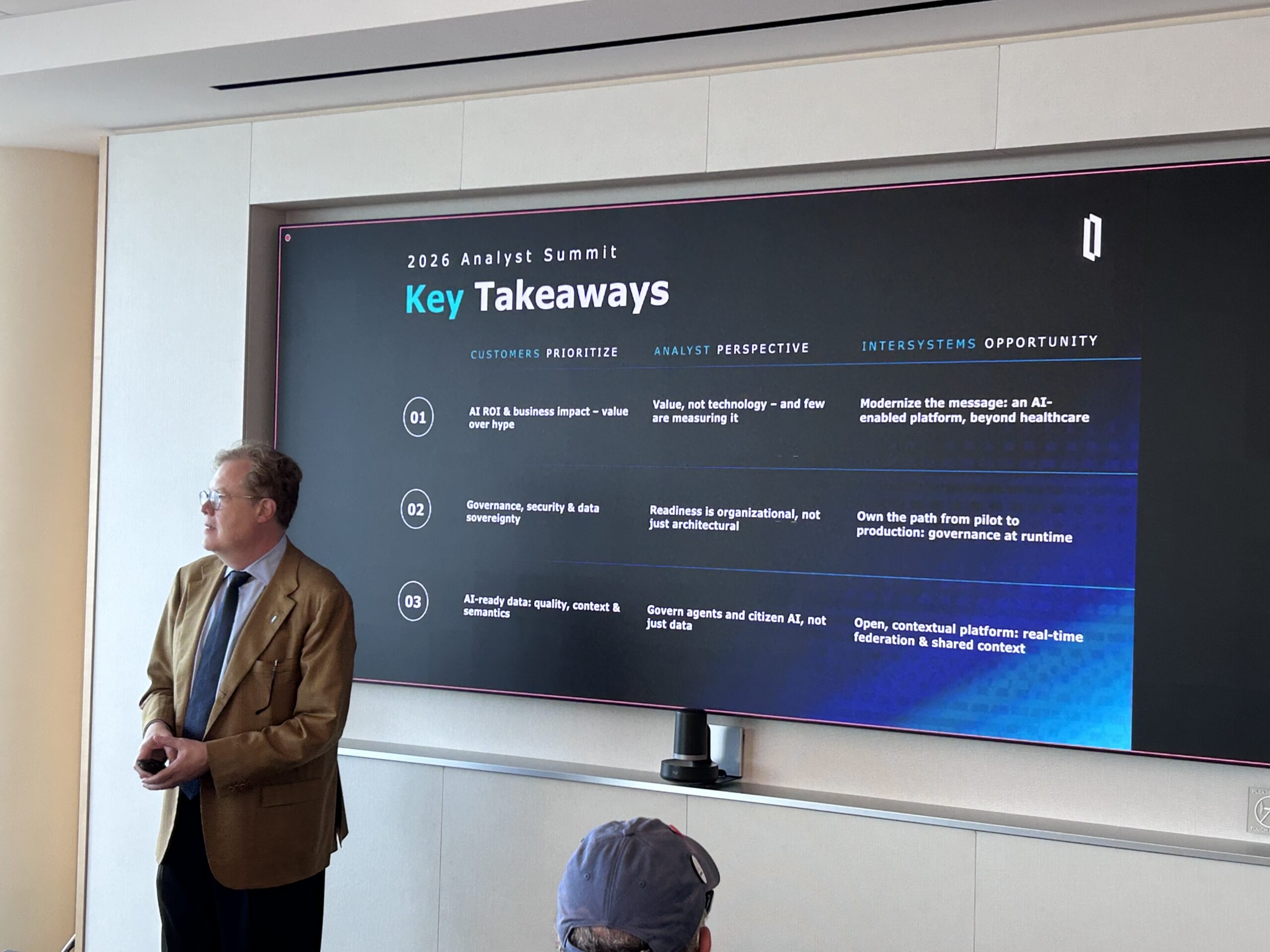
At last month’s summit, Scott Gnau (pictured here) and Michelle Stolwyk detailed how service bus, SOA, streaming, and microservices options help IRIS share data and integrate with third-party elements.
Such capabilities can help Intersystems grow by expanding services within existing accounts and process customers’ data that resides in third-party platforms.
And they showcased 11 new logos last month, ten in healthcare.
In sum:
If you’re a data or AI leader in healthcare, FinServ, or logistics, you should learn more about how Intersystems supports AI-driven, converged workflows.