

Forecast Accuracy Requires More Than Financial Data
-
 By
Tim King
, Executive Editor at Solutions Review
By
Tim King
, Executive Editor at Solutions Review - Best Practices,

BARC’s Kelley Lynn Kassa offers commentary on how forecast accuracy requires more than financial data.
As a Red Sox fan, I know the box score can be both useful and misleading. Even after a recent hot streak, including a sweep of the Yankees, most Boston fans still think this team has been frustrating, inconsistent, and, at times, just plain bad. The final score tells you who won, but not always why. A blown lead may look like one bad inning, but the real drivers could be a tired bullpen, defensive mistakes, injuries, travel schedules, or a lineup that struggles with runners in scoring position.
If you look only at the scoreboard, you miss the conditions that shaped the outcome.
Forecasting works the same way. Financial data shows what happened, but it does not always explain what is changing now or what may happen next.
Forecast accuracy improves when finance teams connect the numbers to the operational signals that drive performance. Those signals often include pipeline quality, pricing, retention, headcount, capacity, demand, supplier constraints, logistics costs, and production throughput.
Forecasting Has Moved Beyond Finance-Only Data
The Planning Survey 26 shows how far expectations have shifted. Among respondents, 78% already use their planning products for forecasting, and 18% plan to do so. Forecasting now sits close to budgeting in adoption, with 85% using planning products for budgeting.
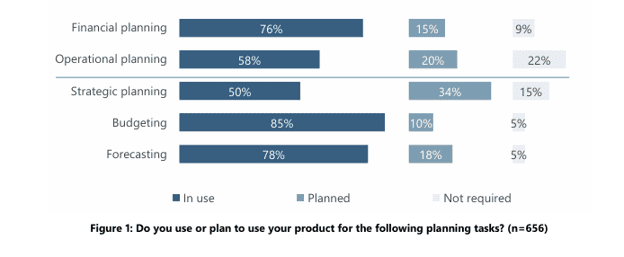
That shift matters because forecasting plays a different role than budgeting. Budgeting sets targets, while forecasting provides a current prognosis of expected results. That prognosis may show whether the organization is on track to meet year-end targets or cover a rolling time horizon (such as the next 12 months). To make that view useful, finance teams need more than general ledger data. They need operational assumptions about demand, capacity, pricing, workforce, supply, and other drivers that influence future performance.
The same survey data supports this broader scope. Of respondents, 58% use their planning products for operational planning, and another 20% plan to do so. Teams increasingly want a single, connected view of financial and operational assumptions before decisions are made.
Accuracy Depends on Drivers and the Data Basis
A forecast built mainly on prior actuals can still help, but it has limits. Historical trends can miss inflection points, understate emerging risks, and create false confidence when business conditions change faster than the reporting cycle.
Driver-based forecasting links outcomes to the assumptions that shape them. Instead of asking only, “What did revenue look like last quarter?” finance teams can ask, “Which drivers are changing, how quickly are they changing, and what does that mean for the forecast?”
The Planning Survey 26 reinforces that point. When asked which approaches matter most for planning, budgeting, and forecasting, 58% selected improving the data basis for planning and forecasting, and 34% selected enhancing operational planning. Leaders emphasized the data basis even more, with 64% selecting it versus 50% of laggards.
Connected Data Is Now a Forecasting Requirement
Forecast accuracy is often framed as a modeling problem. It is just as often a data and integration problem.
Planning teams need reliable actuals, operational measures, assumptions, and business rules. They also need transparency. Teams need to know where data came from, when it was updated, and whether it matches the definitions used across functions.
The Planning Survey 26 highlights the gap between governed planning platforms and spreadsheets. On the Business Benefits Index, specialized planning software scores 8.4 for increased transparency and traceability of planning, compared with 4.7 for Excel. It scores 7.7 for better quality of planning results, compared with 4.1 for Excel. It scores 7.5 for increased planning frequency, compared with 4.0 for Excel.
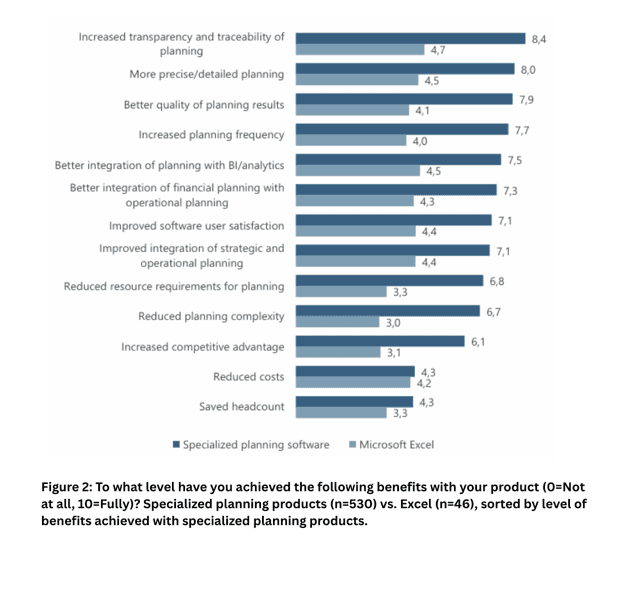
These differences show up in day-to-day forecasting work. When teams rely on spreadsheets, they often spend more time reconciling inputs than improving the forecast. When teams work in connected planning processes, they can focus on drivers, trade-offs, and actions.
AI Raises the Standard, But It Does Not Replace Planning Discipline
Artificial intelligence (AI), machine learning (ML), and generative AI (GenAI) have become part of the forecasting conversation. These capabilities can support suggested values, quality checks, scenario work, and faster variance commentary. However, the usefulness of AI depends on the data foundation and the driver model.
A disconnected planning environment can produce AI output, but it will be hard to trust. Finance leaders still need explainability, auditability, and consistent definitions. That is why forecast accuracy is not an AI-first problem. It is a planning architecture problem.
What Finance Leaders Should Do Next
- Identify the operational drivers that materially affect revenue, margin, cash flow, capacity, or risk.
- Connect financial and operational planning where disconnected assumptions create the biggest variance, delay, or rework.
- Improve the data basis before expanding AI. Data quality, availability, consistency, governance, and transparency shape forecast accuracy.
This is the second article in a series on data foundations and requirements for EPM. Read the first installment, “The Next Planning Challenge isn’t AI, it’s Data”, here.
Tim King
Executive Editor
Tim is Solutions Review's Executive Editor covering the human impact of AI on the future of work and learning. He is also the Media Strategist behind Insight Jam (1M+ on YouTube) events and programming. A 2017 and 2018 Most Influential Business Journalist and 2021 "Who's Who" in multiple categories, Tim is a recognized thought leader in enterprise tech and AI.
- Analytics and Data Science News for the Week of October 9; Updates from ClicData, Databricks, Qlik & More - October 8, 2026
- Analytics and Data Science News for the Week of October 2; Updates from Anaconda, Databricks, Power BI & More - October 1, 2026
- Breaking Down the Wall Between Analytics and Operations: A Practical Guide to Convergence - September 22, 2026