Airport Adventures: The Value of Planning Ahead for Data
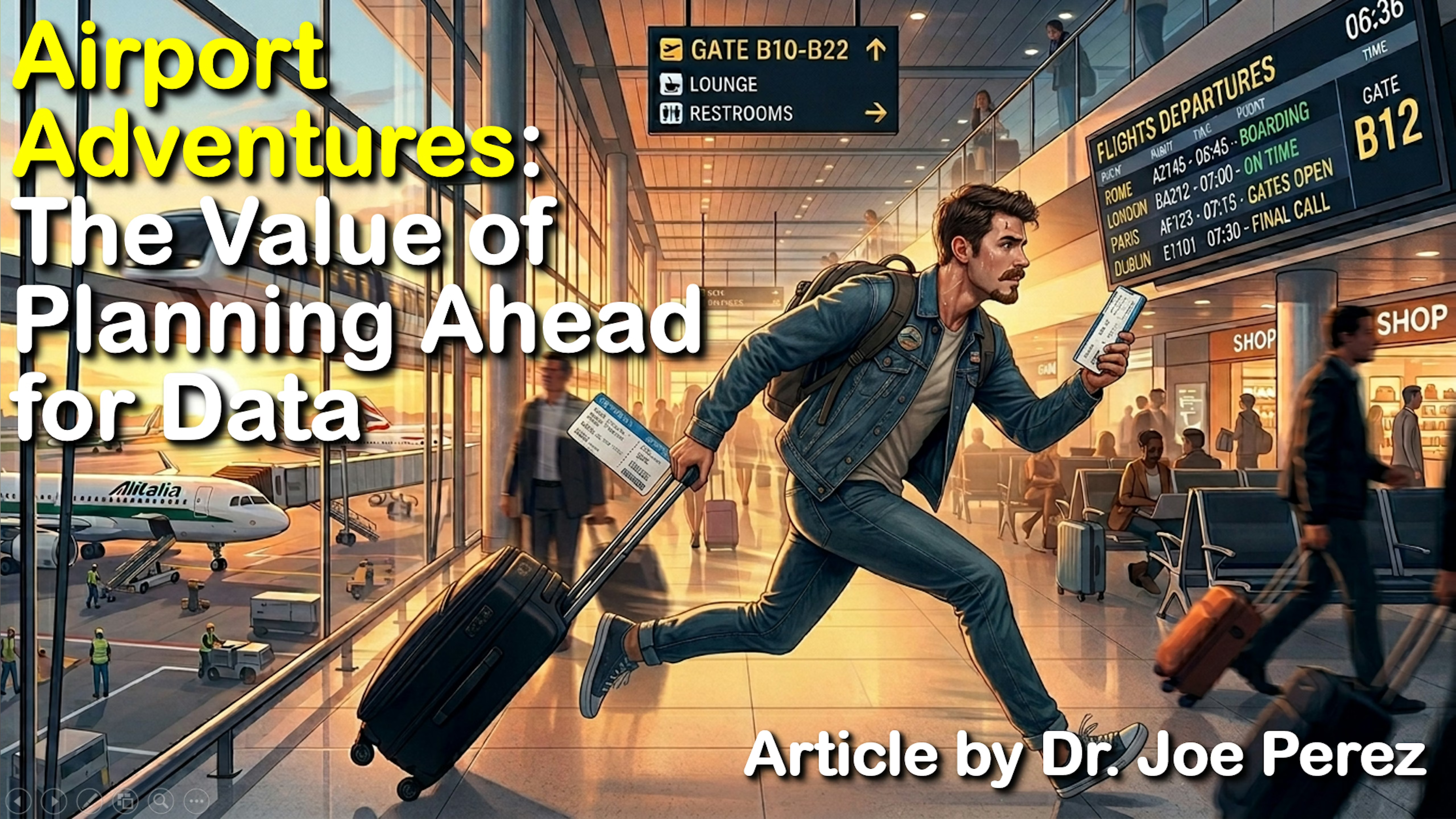
Okay. I’m going to tell you something embarrassing. Actually, I already told a friend of mine, and the fact that I even hesitated to tell HIM (someone who has known me for years), should give you a sense of just how thoroughly I managed to outsmart myself last week.
Here’s the setup: I had boarded my flight from Toronto and landed at the Narita International Airport (code NRT) a week earlier, ready for a fantastic trip to Tokyo to speak at the DevOpsDays conference. After a wonderful, productive work week, I wrapped up my stay, checked out of my hotel at 11 AM on Friday, the day of my return flight, and left for the airport around 11:30. My plan was to roll in somewhere between 1:00 and 1:30 PM, giving me a solid four hours or so before my 6:05 PM departure. Plenty of time. I’d grab some last-minute gifts for the family, breeze through security, and camp out at the gate like the seasoned traveler I fancied myself to be.
There was just one small problem. And I mean this in the same way that the HMS Titanic had “just one small problem.”
When I had arrived at Narita five days earlier, an agent at the information booth had mentioned that a round-trip Narita Express ticket would save me a few bucks over two one-way tickets. About five dollars, to be precise. Five whole dollars. And I, in what I can only describe as a stunning act of out-of-sight, out-of-mind travel brain (perhaps mixed with a little bit of premature senility), bought the round-trip ticket; completely forgetting, in the heat of a busy conference week and sightseeing, that my return flight wasn’t departing from Narita at all.
Let that sink in for just a moment.
I realized the mistake only after I arrived at Narita for my return flight, walked more than a mile from the train station across two terminals, and stopped at an information screen to double-check my gate number. That’s when I noticed my flight wasn’t listed. A closer look at my boarding pass revealed the painful truth: HND, not NRT. In other words, I had gone to the wrong airport. When I texted my friend about it later, I summed it up with a mix of self-deprecation and relief: “Man, I am such an idiot. Good thing I planned to get to the airport super early. Stupid, but good.”
Tokyo, for the uninitiated, has TWO international airports: Narita (NRT) and Haneda (HND). Different sides of the city. Ninety minutes apart (minimum) by express train. And yes, my outbound flight had come into Narita (NRT), but my return flight was departing from Haneda (HND). I hadn’t forgotten that fact when I booked the ticket; after all, it was right there on my itinerary. I just didn’t think of it at the moment I bought my train tickets. I had all the information. I just didn’t connect the dots.

What saved me (other than the amazing grace of God, of course) was time. My overly padded schedule, which I planned because I dislike the stress of cutting it close, turned out to be an unexpected blessing; the single decision that saved my entire trip. I made my flight. Comfortably. I got to the gate with more than 90 minutes to spare, finished my family shopping in the terminal, and sat down with time to breathe. Security and passport control at Haneda? Under six minutes. Six. And the only reason any of that was possible was because I had built a massive buffer into my day from the very start.
That buffer, that deliberately oversized cushion of time, absorbed a crisis that would have been catastrophic otherwise. And the minute I sat down at that gate, I started thinking about how this whole ridiculous episode maps almost perfectly onto something I spend a considerable amount of my professional life talking about: data governance.
Stay with me here for four key observations.
VERIFY
The entire chain of bad events started with an unverified assumption. I assumed my return flight left from the same airport as my arrival. I never double-checked while I was buying my train ticket. In data governance, assumption errors are one of the most underappreciated sources of failure. Organizations routinely build processes, reports, and even entire data pipelines on top of assumptions about where data comes from, what it means, and how it behaves; yet nobody stops to validate whether those assumptions are actually true. According to research grounded in DAMA-DMBOK principles, cascading project failures are frequently traced back to a single unchecked assumption at the start. The fix isn’t complicated. Before you act, before you buy the ticket, before you build the pipeline: verify. Confirm the source. Confirm the destination. Don’t let a five-dollar savings tempt you into skipping the step that matters most.
CLARIFY
I had all the information I needed, right there in my hand. My boarding pass clearly said HND. I just hadn’t looked closely enough at it until I was already standing in Terminal 3 wondering why my flight wasn’t on the departures board. That’s a data quality problem dressed up in an airport uniform. In data environments, metadata exists precisely so that people can understand what they’re looking at: field names, data types, source systems, last-updated timestamps. But metadata helps ONLY if someone actually reads it. Ambiguous field names, inconsistent labeling, incompatible data types, and poorly documented data sources create exactly the kind of confusion that sends whole analytics teams running to the wrong terminal. Poor data quality has been estimated to cost organizations up to 30% of annual revenue when the downstream errors compound. Clarify the details before you commit. HND and NRT are both three-letter codes. They are not the same thing.
AMPLIFY
I arrived at Narita with almost four hours to spare for a flight I didn’t even need to be at Narita for. That buffer (which, again, I had built in simply because I dislike the stress of cutting it close) turned out to be the single decision that saved my entire trip. Had I arrived at a “normal” time, say 90 minutes before departure, I would have missed that flight. No question. The detour ate 90 minutes minimum. In data governance, contingency planning is the organizational equivalent of arriving early. Teams that allocate slack in their project timelines, that set aside time for data validation and quality checks before launch, that build in review cycles before reports go to the board; those teams have room to absorb surprises. Teams that don’t are one unexpected data issue away from a missed deadline, a compliance failure, or a very uncomfortable conversation with senior leadership. Amplify your safety margin deliberately. The extra buffer feels wasteful right up until the moment it isn’t.
RECTIFY
Once I figured out what had happened, I didn’t stand there in Terminal 3 at Narita beating myself up (at least not for very long). A quick visit to the information desk for the best route to Haneda (after a fervent prayer for guidance), and I was hoofing it back to Terminal 2 to buy my $25 ticket and get in line for the Skyliner Express. Fast. The ability to rectify a situation quickly is entirely a function of how much runway you still have. Because I’d planned for an extra 3-plus hours, I had the time to reroute.
Organizations that have strong data governance practices (i.e., clear ownership, documented processes, tested incident response plans, etc.) can recover from data errors, system failures, and compliance surprises in a fraction of the time it takes organizations that are making it up as they go. The actual recovery action (boarding the Skyliner) took seconds to decide. The recovery was possible only because the planning had happened hours earlier.

CONCLUSION
Here’s my takeaway from the whole adventure. I temporarily forgot the details of my flight amidst a busy trip, and I made a preventable mistake. But the smart decision (i.e., leaving the hotel early, padding my schedule, refusing to cut corners on my arrival buffer) ended up being the only thing standing between me and a missed flight home.
The lesson applies whether you’re managing departure gates or data pipelines. One bad assumption, one unread detail, one moment of “it’ll be fine”—any of those things can send you sprinting to the wrong terminal. The question is whether you planned well enough to survive it.
VERIFY. CLARIFY. AMPLIFY. RECTIFY.
Four words that end the same way.
Four habits that keep the chaos manageable.
Cost of learning them the hard way: $25 and a very fast walk through a Japanese airport.
Totally worth it.

Remember: A little humility, a lot of buffer, and a willingness to double-check the details. These are the real travel (and data) essentials.