Five Winning Traits of Agentic Analytics Leaders
Sponsored by Simba Intelligence from insightsoftware Data + Analytics.
Just 27% of AI adopters have reached production with agentic analytics. They modernize BI processes with AI to make faster, smarter decisions. And they achieve this while overcoming the stubborn problems of data quality, skill gaps, and incompatible systems.
What’s their secret?
This blog seeks to answer that question. We use BARC primary research to profile this 27%, whom we call agentic analytics leaders, and identify five winning traits: agentic analytics leaders are mature, governed, measured, adoption-focused, and broad-based in their use of AI. We define each trait below and recommend next steps for the other 73% of organizations to start acquiring them.
Agentic analytics leaders can teach others how to be mature, adoption-focused, governed, measured, and broad-based with AI.
Agentic analytics, as the name suggests, means that agents do analytical work for you. They converse with humans as they connect with distributed data, reason about its meaning, and even make decisions or take actions based on natural language commands. Agents rely on the following foundation:
- A semantic layer that creates and queries data products across multiple sources
- A metadata layer that organizes metadata about structure, usage, and relevance
- Governance controls that enforce policies and monitor compliance
Agentic analytics leaders have a knack for bringing all this together and delivering results. Let’s explore their winning traits.
Mature
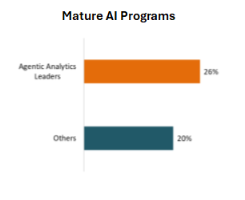
Many AI adopters rush into experiments and even production, only to end up with canceled projects, upset customers, or business disruption. BARC research shows that you can reduce such risks by building a mature AI program that addresses seven elements: executive leadership, program standards/policies, project oversight, enterprise architecture, security, legal considerations, and data access/use policies. Unfortunately, just 20% of AI organizations have mature AI programs—and that number has been flat for two years.
Agentic analytics leaders are further ahead: 26% of them have mature AI programs in place. They have executive leaders that create governed, cross-functional initiatives with a careful balance of risks and rewards. They focus on broadening data access for business managers while maintaining strict guardrails for safe behavior. Other adopters need to catch up. As a first step, they should identify an executive leader, then give that individual the appropriate authority and hold him or her accountable for building a mature AI program.
Mature AI Programs
Governed
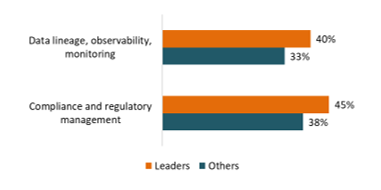
Like all organizations, agentic analytics leaders correctly rate data quality as the top obstacle to AI success. They invest in solutions to improve data accuracy, consistency, and timeliness while strengthening overall governance. In fact, 40% of our leaders are in production with data lineage, observability, and monitoring, compared with 33% of the overall market.
Compliance and regulatory management show a similar pattern: 45% of leaders have tools in production vs. 38%. Nearly all other leaders are researching, testing, or evaluating tools across these categories. Other adopters must catch up to ensure that agentic inputs, outputs, decisions, and actions meet safety standards. To get started, they can extend their existing data governance programs, including policies, rules, and standards, to address the new risks that AI models and agents pose. Then they can define technical controls and evaluate tools to support them.
Governance Controls in Production
Measured
While AI innovation requires ambitious change, agentic analytics leaders modernize their technology in a measured fashion. Two-thirds of them (66%) add AI technology—for example, metadata and semantic layers—to their existing architecture rather than overhauling, consolidating, or migrating it. This measured approach avoids a losing battle with data gravity, migration complexity, and sovereignty requirements. Other adopters should follow suit and start by scoping a departmental project that spans just one or two data platforms.
Agentic analytics leaders add metadata and semantic layers to their existing architecture
Adoption-focused
BI and analytics initiatives have long struggled with low adoption rates. Business users tend to overwhelm data analysts with one-off requests rather than learning to use analytics tools themselves. Agentic analytics aims to correct this problem by enabling business users to converse in natural language rather than learning structured query language (SQL) commands or a graphical interface.
It’s no surprise, then, that agentic analytics leaders rank user adoption as their top measure of AI success. This has universal appeal: whatever your business objective or use case, you need your workforce to become proficient with AI. Adopters should define the right KPIs to track adoption based on the advice of vendors and consultants that understand industry best practices.
Agentic analytics leaders rank user adoption as their top measure of AI success
Broad-based
Agentic analytics forms the tip of the AI spear: companies that get it right can attack many other opportunities as well. Reflecting this, agentic analytics leaders adopt nearly all other use cases in higher numbers than the overall market. For example:
- 61% are in production with document analysis, vs. 51% for the overall market
- 52% are in production with data management and integration vs. 37%
- 40% are in production with robotic process automation vs. 24%
- 33% are in production with supply chain automation vs. 22%
With this in mind, we recommend that adopters define several target use cases that complement agentic analytics. The more you can share tools, systems, and knowledge between use cases, the better you can drive business results with AI innovation.
Follow the leader
The organizations that master agentic analytics today will define the competitive standard for everyone tomorrow. Our five winning traits—maturity, governance, a measured approach, a focus on adoption, and broad-based AI use—offer a clear blueprint that any organization can follow. Data and AI executives can start their journey by taking the steps outlined in this blog.
To learn more about agentic analytics, join the upcoming webinar, “The AI Gold Rush: Separating Gold from Pyrite,” with Shawn Rogers, CEO of BARC, and Shawhin Mosadeghzad, Director of Simba Intelligence at insightsoftware Data + Analytics.