Cloud AI Innovators Teach Us to Modernize Our Teams, Architecture, and Governance
The cloud has spawned rapid AI innovation. Given this, it’s no surprise that all-in cloud adopters have something to teach the rest of the market.
This blog, the second in a two-part series, builds on our earlier profile of organizations that run full AI projects on a single cloud platform. We call them Cloud AI Innovators, and they have a knack for driving business results with production AI. Cloud AI Innovators teach us three guiding principles: (1) foster cross-functional teamwork, (2) streamline architecture, and (3) strengthen governance. Let’s explore each principle in turn.
- Foster cross-functional teamwork
AI fails without human teamwork. This is a serious risk because AI adopters rightly view team culture and change management as more challenging than technology. How do you mitigate such a risk? The Cloud AI Innovator starts by designating an executive to organize humans and agents across functions, creating what McKinsey calls “flat networks of empowered, outcome-aligned agentic teams.” In such networks, humans and agents collaborate to execute multi-step workflows. For example:
- One GenAI agent might serve as the front-line for the customer service team. It fields inquiries, classifies problems, solves simple problems, and routes the others to human experts.
- Another GenAI agent helps the human experts within the IT or engineering teams as they remediate issues.
- A natural-language model, meanwhile, gauges the sentiment of customer conversations and directs churn risks to the sales team.
- Finally, a machine learning model identifies patterns in product usage, issues, and complaints, helping product managers prioritize future development.
Cloud AI Innovators further cultivate cross-functional teamwork like this by training workers on new skills and promoting best practices through centers of excellence.
Fran Bell exemplifies this approach at Ford, starting with her cross-functional role of chief data, AI, and analytics officer. She also chairs Ford’s Enterprise Data Council, which oversees the company’s investments in data, platforms, and technology–reflecting an authority that normally spans multiple business functions. Bell tells Forbes that “we are building powerful ‘human-machine teams’ where AI assists in complex data analysis, runs simulations, and automates repetitive tasks, freeing our talented engineers, designers, and business leaders to focus on what they do best: strategic thinking, creative problem-solving, and building the future of mobility.”
- Streamline architecture
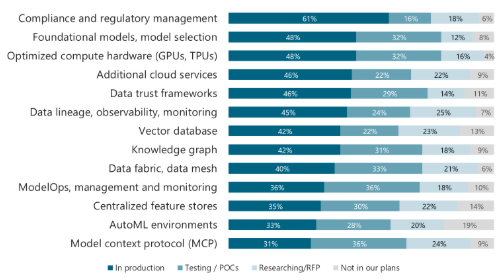
The more you commit to a single platform, the more you reduce friction between software components… and the faster you can put new technology to work. In fact, a recent BARC survey found that users of Google Cloud excel at putting AI tools into production. These Cloud AI Innovators lead the overall market in deployment of every AI-related technology, from GPUs and TPUs to MCP servers, vector databases, and knowledge graphs.
Google Cloud Users’ Deployment of AI-Related Technologies Leads in All Categories (n=96)
The lesson for other adopters? Find ways to gradually shift AI workloads to one cloud, thereby tapping a wide ecosystem of advanced tools that play well together. This does not require migrating and consolidating all your data. Rather, AI teams can replicate a subset of on-premises operational data to the cloud or access the data on-premises using virtual pointers. They also can start by hosting new AI projects on a consolidated cloud rather than ripping and replacing systems for existing projects. Streamlining your architecture in this fashion reduces risk, improves team productivity, and makes the business more agile.
For example, Mattel accelerated its customer feedback process on Google Cloud. Its product quality analytics team used BigQuery, Vertex AI, and multimodal Gemini models to study millions of customer interactions in real time. This helped designers and supply-chain managers rapidly fix hot-button issues such as a malfunctioning Barbie Dreamhouse elevator, saving the company $1 million.
- Strengthen governance
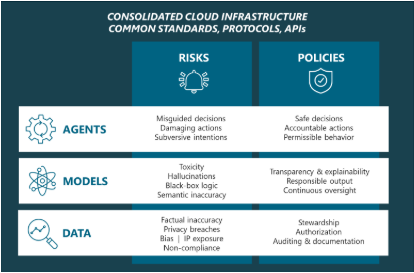
AI adopters must strengthen their data governance programs to make AI inputs more trustworthy, ensure user privacy, and comply with regulations. This is not easy. For starters, data quality now ranks as the #1 obstacle to AI success, up from #6 in early 2024 according to BARC’s latest survey. AI adopters must tackle this problem while also extending their governance programs to mitigate AI model risks such as hallucinations and agent risks such as bad decisions or damaging actions.
Like most organizations, Cloud AI Innovators struggle with governance overall. But nearly 61% of Google Cloud adopters now use compliance and regulatory management tools in production for AI. Our chart above also shows that 46% are in production with data trust frameworks and 45% are in production with data lineage, observability, and monitoring. Such technologies improve the ability of governance teams to mitigate risks by enforcing policies with strong technical controls. A streamlined cloud infrastructure, coupled with common standards, protocols, and APIs, simplifies this effort.
As a case in point, Ericsson established a data governance framework based on Google Dataplex Universal Catalog. This catalog served as the foundation for a universal glossary that standardized business terminology to give decision makers a common language. Dataplex Universal Catalog also governs data discovery processes; centralizes metadata for classification, compliance, and lineage; and automates data quality checks.
Mitigating Governance Risks with Policy Enforcement on a Consolidated Cloud
Getting started
Cloud AI Innovators demonstrate that success comes from aligning people, platforms, and policies. This includes organizing cross-functional human–agent teams, shifting AI workloads to a streamlined cloud architecture, and strengthening governance to ensure responsible AI at scale. Together, these practices reduce risk and accelerate the path from experimentation to business value. Data and AI leaders should act now by appointing executive owners of AI initiatives and empowering them to modernize both architecture and governance.